Rotary Screw vs Reciprocating Compressor: Which Is Better?
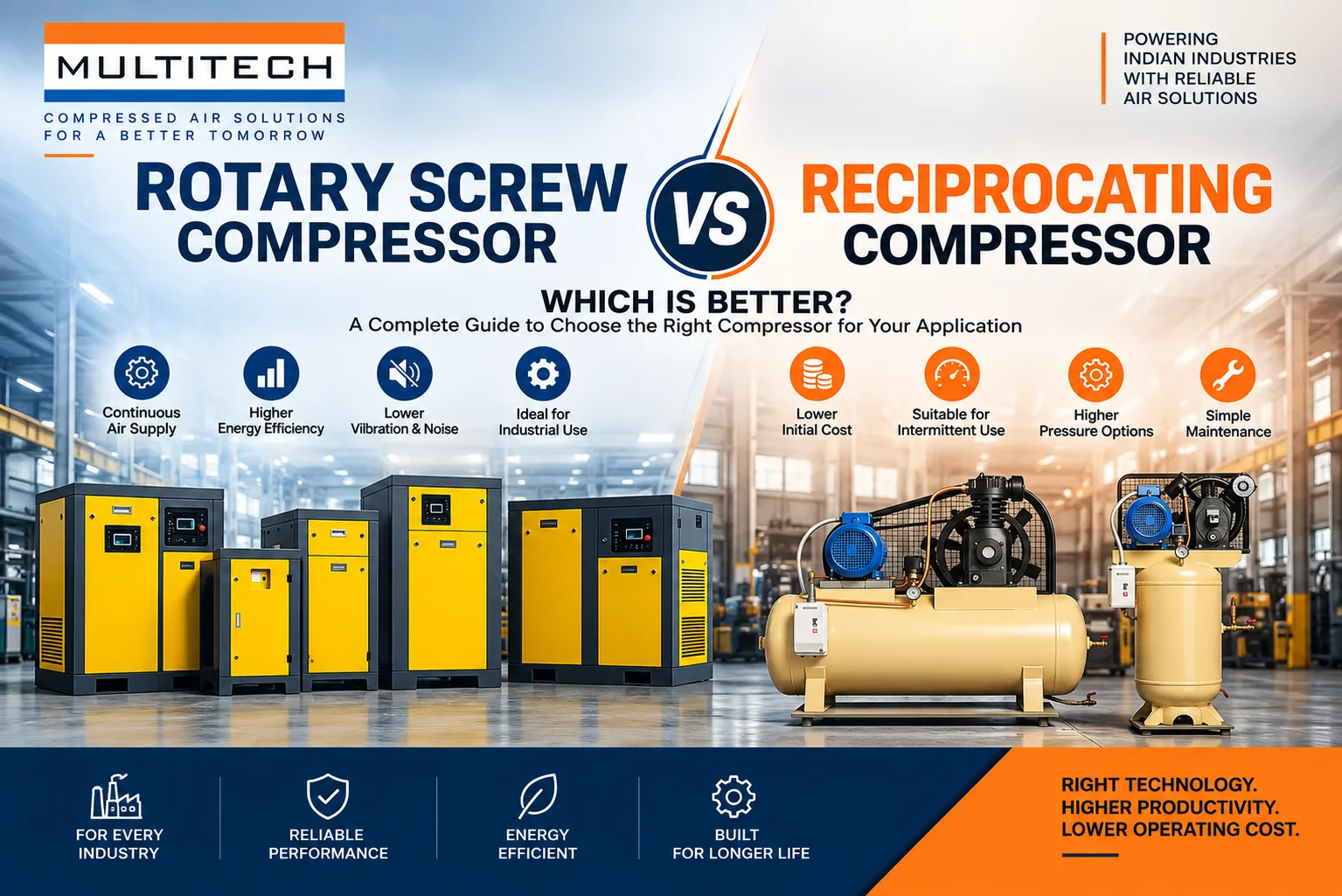
Choose a rotary screw compressor when production needs steady compressed air for long hours, comparatively stable flow, lower vibration and easier integration into a central air system. Choose a reciprocating compressor when demand is intermittent, the required flow is modest, higher pressure is needed from a smaller package, or a lower initial purchase cost matters more than continuous-duty efficiency.
Neither technology is automatically “better.” The right decision comes from measured air demand, required pressure at the point of use, duty cycle, air-quality class, site conditions and life-cycle cost. MultiTech supplies both rotary screw air compressors and reciprocating piston compressors, so the comparison should begin with the application rather than a preferred machine type.
How the two compressor types work
Rotary screw compressor
A rotary screw machine draws air into a compression element containing two intermeshing helical rotors. As the rotors turn, the trapped volume becomes smaller and pressure rises. Oil-injected designs use oil for sealing, cooling and lubrication, followed by separation and filtration. Oil-free designs keep oil away from the compression chamber and are considered where process-air contamination risk is critical.
Reciprocating compressor
A reciprocating compressor uses a piston moving inside a cylinder. Air enters through an inlet valve during the suction stroke and is compressed during the return stroke before discharging through an outlet valve. Single-stage and multi-stage arrangements serve different pressure ranges. Receivers help manage intermittent demand and reduce start-stop frequency.
Rotary screw vs reciprocating compressor at a glance
| Decision factor | Rotary screw | Reciprocating |
|---|---|---|
| Best demand pattern | Steady or high-duty demand | Intermittent or low-duty demand |
| Flow character | Relatively smooth | Pulsating |
| Noise/vibration | Generally lower | Generally higher |
| Footprint per unit flow | Often compact at medium/high flow | Attractive at lower flow |
| Initial cost | Usually higher | Usually lower |
| Maintenance focus | Oil, separators, filters, coolers | Valves, rings, belts, lubrication |
| Typical selection strength | Continuous plant air | Workshop, backup or higher-pressure duty |
1. Duty cycle is the first filter
Duty cycle is the share of time a compressor is expected to run within a defined period. If a production line consumes air almost continuously across a shift, a properly sized rotary screw compressor is usually the stronger starting point. If tools run briefly and the receiver has time to recover, a reciprocating machine may be more economical.
Do not confuse motor run time with useful loaded run time. An oversized screw compressor may spend excessive time unloaded, consuming power while delivering little air. A reciprocating unit forced into continuous service may overheat or wear prematurely unless it is specifically rated for that duty. Ask the supplier for allowable duty and control behaviour at the actual operating point.
2. Calculate flow from measured demand
List every air user, its required flow, pressure, operating duration and simultaneity. Add real leakage and a justified growth allowance—not a blanket oversizing percentage. Where possible, perform data logging of header pressure, compressor power and flow over representative shifts. A short peak might be handled by storage; a sustained peak usually requires compressor capacity.
Flow units must be defined. Free-air delivery, inlet conditions and stated cubic-feet-per-minute values are not interchangeable without reference conditions. Compare vendor offers at the same pressure and reference standard. MultiTech’s broader compressed-air product range can help coordinate the compressor with treatment and downstream equipment.
3. Select pressure at the point of use
Pressure is not a substitute for capacity. Begin with the highest legitimate end-use pressure, then account for pressure drop through dryers, filters, piping and controls. Increasing compressor discharge pressure to compensate for undersized pipes or blocked filters increases energy use and hides the root cause.
Reciprocating compressors are often considered for smaller-volume, higher-pressure duties. Rotary screw compressors commonly serve central plant-air systems at moderate industrial pressures. Always use the manufacturer’s performance curve and verify maximum working pressure, relief devices and receiver rating.
4. Compare energy at the real load profile
Purchase price is visible; electricity dominates many compressor life-cycle budgets. Compare specific power at the required pressure, not motor nameplate alone. Review full-load efficiency, part-load control, unload power, starts per hour and annual operating hours. A variable-speed screw compressor can follow varying demand, but it still needs a stable operating range and appropriate base/trim strategy.
For intermittent demand, shutting down a reciprocating compressor between cycles can be efficient. For stable high demand, a screw compressor near its design point can avoid frequent cycling. In multi-compressor rooms, sequencing controls can keep the most efficient machines loaded and use one trim machine to follow variation.
5. Account for air quality and treatment
The compressor choice does not alone determine delivered air quality. Ambient humidity, aftercooling, receiver design, dryers, filters, drains, piping and maintenance all matter. Food, pharmaceutical, medical, electronics and painting applications may require low particles, low moisture and tightly controlled oil contamination.
Where oil contamination is unacceptable, evaluate oil-free air compressor options and validate the complete treatment train. MultiTech also lists compressed-air filters and heatless desiccant dryers. Define the required ISO 8573-1 purity class at the point of use before sizing treatment.
6. Plan maintenance and uptime
Rotary screw maintenance commonly includes lubricant, oil filter, air filter, separator element, belts or coupling, coolers, drains and control checks. Reciprocating machines add attention to valves, piston rings, cylinder condition, belts, lubrication and vibration. Service intervals depend on design, hours, load, ambient dust and temperature.
For critical production, design maintainability into the system: isolation valves, bypass arrangements where appropriate, accessible filters, spare capacity, service clearances and a documented parts plan. A cheaper compressor that causes an unplanned shutdown can become the most expensive option.
7. Consider noise, heat and installation
Both compressor types reject nearly all input power as heat. Confirm room ventilation, cooling-air paths and maximum ambient temperature. Avoid recirculating hot exhaust into the intake. Rotary screw packages are often enclosed for lower sound levels, while reciprocating units can transmit more pulsation and vibration. Foundations, flexible connections and acoustic treatment should follow the supplier’s instructions.
Provide clean intake air, drainage, electrical protection, earthing, safe access and adequate receiver placement. Pipe velocity and pressure-drop calculations matter. A well-selected compressor connected to an undersized, wet or leaking network will still deliver poor results.
Application-based recommendations
Manufacturing line with steady two-shift demand
Start with a rotary screw compressor sized from logged demand. Review fixed-speed versus variable-speed control, and consider multiple compressors where production cannot tolerate one-machine failure.
Automotive workshop with intermittent tool use
A reciprocating compressor with a correctly sized receiver may provide the best balance of capital cost and operating pattern. Confirm that peak tools do not create unacceptable pressure dips.
Laser cutting, PET blowing or another higher-pressure process
Do not generalize from plant-air selection. Obtain pressure, flow and air-quality requirements from the equipment manufacturer and evaluate a dedicated multi-stage or specialized compressor package.
Food, pharmaceutical or medical process
Treat contamination risk as a system requirement. Consider oil-free compression, suitable dryers, validated filters and monitoring. A risk assessment and the user’s applicable quality standards must govern the design.
A seven-step buying checklist
- Measure demand over representative production periods; record minimum, average and peak flow plus pressure.
- Define acceptable pressure at each critical point of use and calculate treatment and distribution losses.
- State operating hours, shift pattern, duty cycle, ambient temperature, dust and ventilation conditions.
- Define air-quality class and dew point, then size filters and dryers at actual pressure and temperature.
- Compare specific power and annual energy at the expected load profile, including unloaded operation.
- Review maintenance access, consumables, response time, backup plan, warranty and operator training.
- Request a written performance schedule and scope that covers compressor, receiver, treatment, controls, piping interfaces and commissioning.
Common selection mistakes
Avoid choosing only by horsepower, copying the old compressor size, adding excessive pressure “for safety,” ignoring leaks, or treating peak flow as continuous demand. Do not compare quotations that use different flow reference conditions or omit dryers, filters and pressure drop. Finally, do not assume that a variable-speed drive cures poor sizing; it improves control only within the machine’s efficient operating envelope.
MultiTech describes installation training, after-sales support and maintenance services on its live site. Review About MultiTech and its air-compressor articles while preparing questions for a technical review.
Worked example: selecting for a two-shift factory
Suppose a factory logs average demand of 420 CFM, a sustained peak of 560 CFM and short bursts to 700 CFM at a required header pressure of 7 bar. The correct response is not simply to buy a 700 CFM machine. The engineer first checks whether the short burst can be served by a local receiver and whether leakage or artificial demand explains part of the peak. Treatment pressure drop and the most remote point-of-use pressure are also verified.
One possible architecture is a base-load fixed-speed screw compressor plus a smaller variable-speed trim unit, with storage sized for the event duration. Another is two equal machines sequenced for redundancy. Annual energy modelling decides between them. The team also specifies dryer capacity at the actual inlet temperature, condensate management, ventilation and isolation so one unit can be serviced without stopping essential production.
Total cost of ownership model
Build a five- or ten-year model that includes equipment, treatment, receiver, installation, electrical work, floor or foundation work, ventilation, expected electricity, consumables, planned labour, major overhauls and the financial consequence of downtime. Apply realistic annual hours and electricity tariffs. For efficiency comparisons, use vendor performance at the same pressure and inlet conditions and include unload or off-load power.
Sensitivity testing is valuable. Calculate what happens if production increases 20 percent, if leaks add 10 percent demand, or if ambient temperature raises dryer load. A design that looks cheapest under one ideal assumption may become expensive in the likely operating range. The model should also assign value to redundancy and service response rather than treating reliability as free.
Commissioning and first-90-day checks
Commissioning should verify rotation, safeguards, set points, load/unload control, receiver relief devices, drains, dryer dew point, filter differential pressure, ventilation and leaks. Record baseline pressure, flow, power and temperature. During the first 90 days, compare measured specific power and pressure stability with the proposal, correct leaks, review alarms and retrain operators. That baseline makes later maintenance decisions evidence-based rather than reactive.
Distribution-system improvements before adding capacity
A compressor project is a good time to audit the network. Repair audible and ultrasonic leaks, isolate unused branches, remove inappropriate open blowing, reduce pressure at applications that do not need full header pressure and replace blocked filters. Check ring-main sizing and drops to high-demand machines. These steps may defer a purchase or allow a smaller, better-loaded compressor.
Separate genuinely high-pressure users when feasible. Raising the entire plant from 7 bar to 10 bar for one machine wastes energy and increases leakage everywhere. A dedicated booster or local solution may be more efficient. Likewise, point-of-use storage can support brief events without forcing the central compressor to follow every second-by-second peak. Any change should retain pressure-vessel safety, drainage and inspection requirements.
Frequently Asked Questions
1. Which compressor is better for continuous use?
A properly sized rotary screw compressor is generally preferred for steady, high-duty plant air. Confirm the manufacturer’s duty rating and actual load profile. Verify the final answer using the selected model’s performance curve, duty rating, site conditions and the supplier’s written system recommendation.
2. Which type has the lower purchase price?
Reciprocating compressors often cost less at smaller capacities, but purchase price should be compared with energy, maintenance and downtime over the intended life. Verify the final answer using the selected model’s performance curve, duty rating, site conditions and the supplier’s written system recommendation.
3. Which compressor is more energy efficient?
Efficiency depends on size, pressure and load profile. Compare specific power and control losses at the expected operating points rather than relying on technology labels. Verify the final answer using the selected model’s performance curve, duty rating, site conditions and the supplier’s written system recommendation.
4. Can a reciprocating compressor run all day?
Some industrial reciprocating models are designed for high duty, while others require cooling periods. Use the exact manufacturer rating. Verify the final answer using the selected model’s performance curve, duty rating, site conditions and the supplier’s written system recommendation.
5. Is a rotary screw compressor quiet?
It is often quieter and smoother than a comparable reciprocating unit, especially in an acoustic enclosure, but published sound data and installation conditions should be checked. Verify the final answer using the selected model’s performance curve, duty rating, site conditions and the supplier’s written system recommendation.
6. What receiver size do I need?
Receiver sizing depends on flow swings, allowable pressure band, compressor control and event duration. Have the supplier calculate it; a receiver does not replace sustained capacity. Verify the final answer using the selected model’s performance curve, duty rating, site conditions and the supplier’s written system recommendation.
7. Does higher pressure provide more air?
It may temporarily alter tool behaviour, but it increases energy and stress. Correct inadequate flow, pipe losses or storage instead of raising pressure without analysis. Verify the final answer using the selected model’s performance curve, duty rating, site conditions and the supplier’s written system recommendation.
8. When is a variable-speed compressor useful?
It is useful when demand varies within its efficient modulation range. Stable base load may be served efficiently by fixed-speed equipment with proper sequencing. Verify the final answer using the selected model’s performance curve, duty rating, site conditions and the supplier’s written system recommendation.
9. Do I need an air dryer?
Use one when the required pressure dew point, product quality or equipment reliability cannot tolerate the moisture remaining after cooling and separation. Verify the final answer using the selected model’s performance curve, duty rating, site conditions and the supplier’s written system recommendation.
10. Is oil-free compressed air completely contamination-free?
Oil-free compression reduces one source of oil, but intake air, pipes and downstream components still matter. Validate the whole system against the required purity class. Verify the final answer using the selected model’s performance curve, duty rating, site conditions and the supplier’s written system recommendation.
11. How often should a compressor be serviced?
Follow the manufacturer’s hour- and time-based schedule, adjusted for heat, dust, load and condition monitoring. Keep service records. Verify the final answer using the selected model’s performance curve, duty rating, site conditions and the supplier’s written system recommendation.
12. What data should I send for a quotation?
Send flow, pressure, duty cycle, operating hours, air-quality target, site conditions, electrical supply, redundancy requirement and downstream treatment needs. Verify the final answer using the selected model’s performance curve, duty rating, site conditions and the supplier’s written system recommendation.
Choose the Compressor Around Production, not the Nameplate
A defensible compressor decision starts with logged demand and ends with delivered pressure, air quality and uptime at the machine. Share your flow profile, duty cycle and process requirements with MultiTech so the compressor, storage and treatment can be evaluated as one system. Contact MultiTech Compressors for a project-specific selection and quotation.





-

Rotary Screw Air Compressor Price What Determines the Cost
-
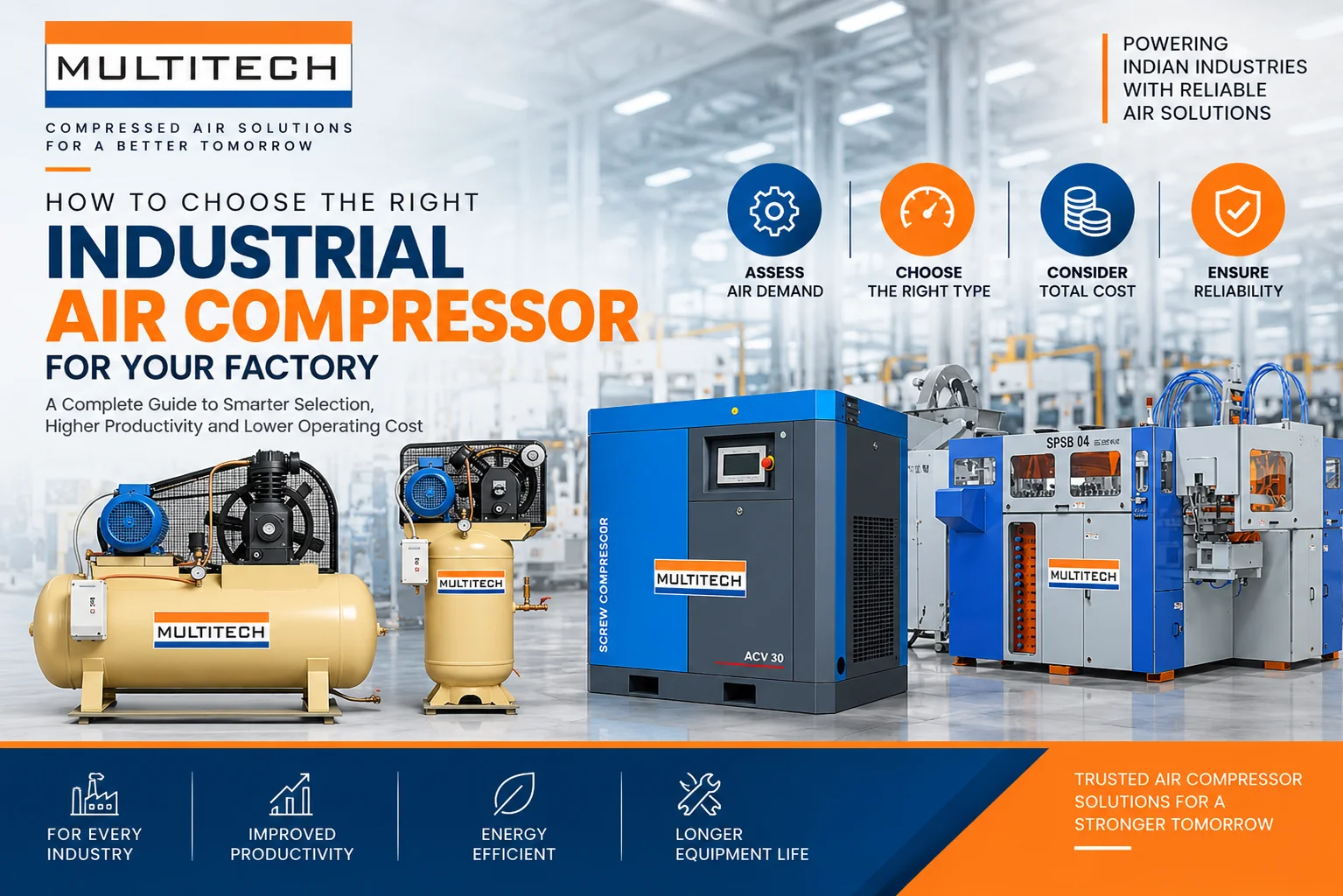
How to Choose the Right Industrial Air Compressor for Your Factory
-

Air Compressor Price in India Complete
-
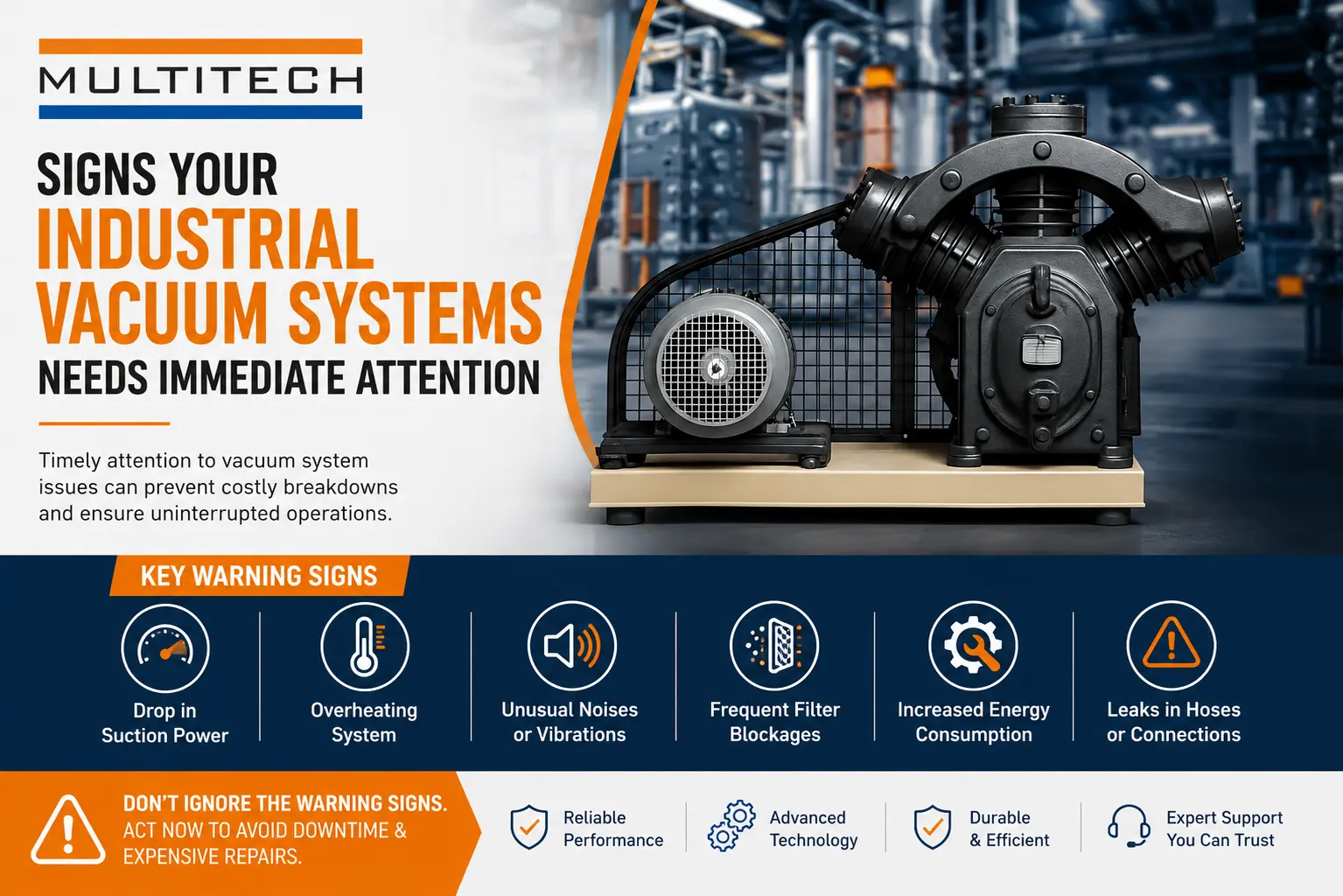
Signs Your Industrial Vacuum Systems Needs Immediate Attention
-
Ultimate Guide to Industrial Air Compressors: Types, Uses, and Maintenance Tips