Liquid Ring Vacuum Pump: Applications and Selection Factors
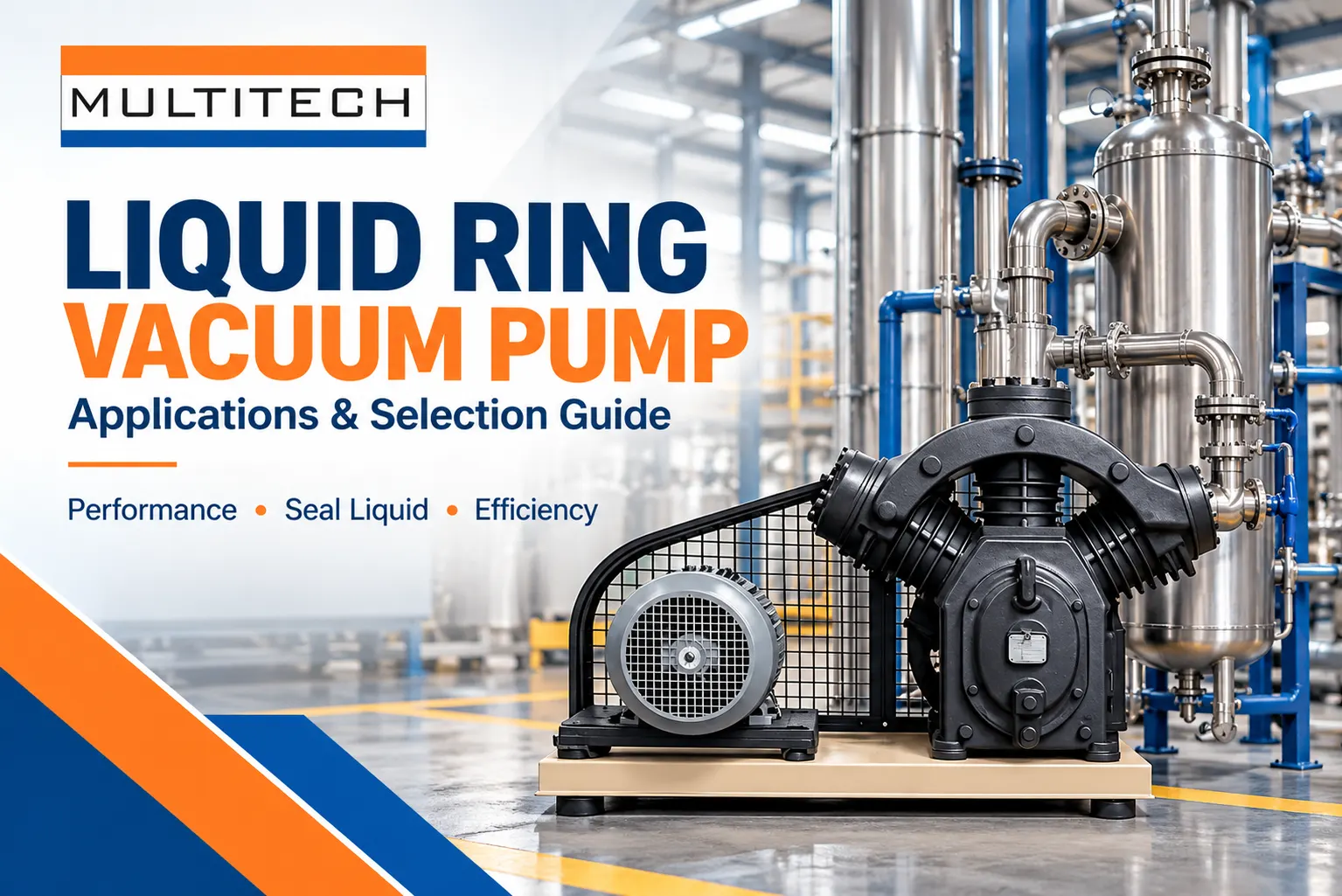
A liquid ring vacuum pump is a rotating positive-displacement machine that uses a circulating liquid to form moving compression chambers around an eccentrically mounted impeller. It is often considered when the process gas is wet, contains condensable vapour, or benefits from relatively cool, oil-free compression. Correct selection depends on required inlet pressure, actual gas load, vapour composition, seal-liquid temperature, materials, service system, controls and site conditions—not only motor power or nominal free-air capacity.
Multitech lists vacuum pumps, including liquid ring variants, within its industrial equipment range. A supplier quotation should be based on a completed process data sheet and a defined duty point. Final design must also cover discharge handling, utilities, hazardous-area requirements, mechanical integrity and process safety under the applicable project standards.
How the Liquid Ring Principle Works
The impeller rotates off-centre inside a cylindrical casing. Centrifugal force throws the seal liquid toward the casing, creating a ring. Because the impeller is eccentric, the volume between blades and liquid increases on the inlet side and decreases toward discharge. Gas enters the expanding spaces, becomes compressed as the spaces contract and exits with part of the liquid. The liquid provides the seal and absorbs heat.
This operating principle allows handling of saturated gas and some liquid carryover better than many dry or oil-sealed technologies, but it also makes performance sensitive to seal-liquid vapour pressure and temperature. The pump does not eliminate process liquids: the discharge mixture needs separation, cooling, treatment, recovery or disposal. The system around the pump can be as important as the pump itself.
| Selection input | Why it matters | Specify |
|---|---|---|
| Suction pressure | Sets compression duty and pump stage | Absolute pressure across the operating range |
| Gas and vapour load | Sets capacity and condensation behaviour | Mass or volumetric flow with conditions |
| Seal liquid | Affects vacuum, materials and utilities | Type, temperature, flow and quality |
| Materials | Control corrosion and contamination risk | Casing, impeller, shaft and seals |
| Operating mode | Changes auxiliaries and consumption | Once-through, partial or total recirculation |
| Site condition | Changes correction and motor duty | Altitude, ambient, power and area class |
Applications That Suit Liquid Ring Pumps
Typical duties include vacuum filtration, evaporation, drying, distillation, deaeration, priming, condenser air extraction, gas recovery and process vacuum in chemical, pharmaceutical, food, paper, power and general manufacturing facilities. Suitability depends on the actual gas and liquid chemistry, hygiene needs and required vacuum. A broad industry label is not enough to select materials or service arrangement.
The technology can be attractive where inlet gas carries condensable vapour because condensation inside the pump may reduce the volumetric gas load. It can also tolerate limited entrained droplets, subject to the supplier’s stated limits. It is less attractive where very deep vacuum, extremely low utility consumption, strict solvent recovery or seal-liquid contamination makes another technology more appropriate.
Define the Duty in Absolute Pressure
State suction pressure as absolute pressure, not an ambiguous gauge vacuum percentage. Provide normal, minimum and maximum pressure as well as start-up condition. The required pressure at the process vessel differs from pump-inlet pressure when piping, valves, filters, condensers and knock-out vessels create losses. Include simultaneous loads and control philosophy rather than sizing every connected point as permanently at peak.
Specify discharge pressure and destination. Backpressure increases power and may reduce capacity. For variable processes, provide an operating map with time at each condition. The supplier can then assess a single- or two-stage pump, speed control, inlet throttling, staged machines or a different arrangement. One headline capacity at atmospheric inlet does not establish performance at the required vacuum.
Calculate the Actual Gas and Vapour Load
Separate permanent gas, air leakage, displaced air, reaction gas and condensable vapour. State composition, molecular weight, inlet temperature, saturation and contaminants. Convert flows to consistent reference conditions and give uncertainty or turndown. Large conservative allowances can oversize the pump and increase seal-liquid, cooling and motor demand; insufficient allowance can prevent the process reaching pressure.
Estimate leakage from equipment, seals and connections using the project method, not a universal percentage. Batch evacuation requires volume and target pump-down time as well as steady leakage. A receiver, vessel or chamber may create a high start-up load followed by a small holding load. Ask the supplier to show the pump-down calculation and assumptions.
Seal-Liquid Temperature Sets the Vacuum Limit
Water is common, but its vapour pressure rises with temperature. Warm seal water occupies part of the pump’s volumetric capacity and limits achievable suction pressure. Supplier performance curves are normally tied to stated water and gas conditions. Correct the selection for the actual inlet gas, seal-liquid temperature, altitude and discharge condition. Chilled water may improve duty but adds energy and condensation considerations.
Other liquids may be selected for compatibility, solvent recovery, freezing risk or process contamination. Their density, viscosity, vapour pressure, heat capacity and safety properties alter performance and design. Never substitute a process liquid for water without supplier confirmation. Define make-up quality, solids, scaling tendency and allowable temperature rise so the service remains stable over time.
Choose the Seal-Liquid System
A once-through system sends the discharged liquid to treatment or drain and uses fresh make-up. It is simple but can consume significant water and create an effluent issue. Partial recirculation returns some separated liquid with make-up and bleed. Total recirculation uses a separator, pump or pressure balance and heat exchanger to reuse most liquid. The best choice depends on water, contamination, heat load and environmental constraints.
Size the separator for gas–liquid disengagement across the operating range. Define level control, overflow, vent, drain, make-up, bleed and heat-removal duty. Closed recirculation can accumulate contaminants, so water or liquid quality still needs management. Request a utility balance showing make-up, cooling water, electrical load and discharge, not only the main motor rating.
Materials and Corrosion Compatibility
Select wetted materials from gas, condensate and seal-liquid chemistry at operating temperature. Review casing, impeller, shaft, port plate, fasteners, seals, separator and piping as one system. Carbon steel, cast iron, bronze and stainless grades have different corrosion, erosion and contamination behaviour. A generic “stainless” description is incomplete without grade and scope.
Consider chlorides, acids, alkalis, solvents, dissolved oxygen, abrasive particles and cleaning chemicals. Mixed materials may introduce galvanic effects. Erosion can occur where droplets or solids strike at velocity. Request corrosion allowance, coating or passivation details where relevant. If product purity matters, confirm whether any wear, corrosion product or service liquid can return to the process.
Single-Stage, Two-Stage and Hybrid Arrangements
A single-stage liquid ring pump serves many moderate-vacuum duties. A two-stage design can improve performance at lower suction pressures by dividing compression. Ejector or booster combinations may extend range for a specific process. The correct arrangement depends on duty curve, gas composition, utilities, capital cost and operating hours. Do not choose stages from target pressure alone.
Ask for guaranteed capacity and power at normal and worst cases, with the exact service-liquid condition. Review performance away from the design point and during start-up. A machine that meets minimum pressure with unusually cold water may fail during summer. Multitech also presents dry vacuum pumps; comparing technologies on the complete duty can reveal a better lifecycle fit.
Motor, Power and Starting Requirements
Motor selection must cover absorbed power across start-up, normal, upset and discharge conditions with the specified margin and service factor. Check voltage, frequency, efficiency class, enclosure, ambient, altitude and hazardous-area classification. Starting against a flooded or high-pressure condition can overload equipment. The sequence should establish correct liquid level, valves and rotation before process load.
Variable-speed control can reduce capacity or hold pressure in some ranges, but minimum speed, seal formation, motor cooling and resonances need supplier approval. Inlet throttling or recycle may be more appropriate for a narrow control band. Request power curves rather than one rated value, then include recirculation pump, cooler fan or cooling-water pumping in the energy comparison.
Piping, Separators and Process Protection
Keep suction piping short and adequately sized, with drainage and supports that prevent nozzle loads. Use a knock-out vessel where slug carryover can exceed pump tolerance. Protect against solids and foreign objects without creating excessive pressure drop. Slope condensate lines appropriately and avoid pockets that can flood unpredictably. Provide isolation and safe venting for maintenance.
The discharge contains gas, vapour and seal liquid. Its separator and vent must suit flammability, toxicity, odour and environmental controls. Do not vent hazardous or valuable vapours simply because the pump can handle them. Coordinate flare, scrubber, recovery or safe-stack requirements. Verify relief or pressure-protection needs for blocked outlets and abnormal heating with the process-safety team.
Instrumentation and Control Philosophy
Typical measurements include suction pressure, separator level, seal-liquid flow and temperature, discharge pressure, motor current and bearing or casing condition as required. Interlocks may protect against loss of service liquid, high temperature, high level, blocked discharge or motor overload. Alarm and trip setpoints should come from the approved design and supplier limits.
Define start, stop, standby changeover, pressure control and process permissives. For critical service, assess duty/standby pumps and automatic transfer. A standby unit is useful only if isolation valves, controls and common utilities cannot disable both machines. Provide local indication and integrate essential signals with the plant control system. Test every interlock during commissioning.
Efficiency, Water Use and Lifecycle Cost
Compare guaranteed power at the actual duty, not motor nameplate or atmospheric free-air displacement. Add seal-liquid make-up, cooling, treatment, effluent, maintenance and downtime. A total-recirculation package may cost more initially but reduce water demand; however, fouling and cooler maintenance can offset savings. Use local utility costs and annual operating profile for the comparison.
Oversizing can waste both electricity and water. Variable process demand may favour parallel smaller pumps or controlled speed, provided minimum stable operation is respected. Track specific power, make-up flow and achieved pressure after commissioning. A worsening trend can indicate scale, heat-exchanger fouling, air leakage, worn internals or incorrect valves rather than a need for a larger pump.
Installation and Commissioning Checks
Confirm foundation, alignment, grout, piping strain, coupling guard, rotation, lubrication and seal-liquid connections. Flush new piping and clean the separator before start-up. Verify instrument calibration and valve positions. Establish seal-liquid flow and level using the supplier procedure, then start under controlled load. Record vibration, noise, temperatures, pressure, flow and motor current.
Demonstrate normal duty, turndown, start-up, shutdown, standby transfer and alarms. Reconcile measured performance with the guaranteed basis and account for actual gas and water conditions. Inspect for cavitation, unstable level, carryover and abnormal discharge. Provide baseline readings and a signed test sheet. Multitech’s contact page offers a verified route for duty-specific product and service discussion.
Maintenance and Troubleshooting Priorities
Routine work may include checking seal-liquid quality and flow, separator level, strainers, cooler cleanliness, bearings, seals, coupling, vibration and corrosion. Follow the exact manufacturer schedule. Preserve alignment when removing components and keep openings clean. Maintain spares based on lead time and criticality, including gaskets, seals, bearings and instruments as appropriate.
Loss of vacuum can come from process leakage, warm seal liquid, low flow, backpressure, worn internals, incorrect rotation, blocked passages or a bad instrument. High power can result from excess liquid, backpressure, mechanical contact or operating outside the intended range. Diagnose the system before dismantling the pump. Multitech’s About Us page provides company context; the accepted manual and service terms should govern the installed unit.
A Buyer’s RFQ Checklist
Issue normal, minimum and maximum suction pressure; gas and vapour composition; flow at defined conditions; inlet and discharge temperature; discharge pressure; seal-liquid availability; contaminants; turndown; batch volume; required pump-down time; site utilities; ambient; altitude; area classification; materials and applicable standards. State whether the seller supplies base, motor, coupling, separator, cooler, controls and commissioning.
Request performance curves, guarantee points, utility balance, materials list, general arrangement, nozzle loads, foundation data, motor data, controls narrative, inspection plan, test certificates, noise, vibration, preservation, spares, documentation, warranty and service response. A technically complete quotation makes capital and lifecycle comparisons possible and reduces late package interfaces.
Cavitation, Noise and Operating Stability
Operation close to the seal liquid’s vapour pressure can create cavitation, noise, vibration and damage. The usable vacuum limit therefore depends on liquid temperature and the supplier’s minimum-pressure guidance. A cavitation-control or gas-admission arrangement may protect the pump, but it changes achievable pressure and process performance. Do not treat a noisy pump as normal simply because it still produces vacuum.
Review transient conditions such as rapid valve closure, loss of cooling, sudden condensable load and separator flooding. Stable level and temperature control help keep the machine on its expected curve. Baseline sound, vibration, inlet pressure and service-liquid temperature during commissioning, then investigate departures together; changing one variable without checking the process can move the problem elsewhere in the package.
Package Responsibility and Vendor Boundaries
Write a responsibility matrix for pump, motor, base, coupling, guard, separator, recirculation pump, cooler, instruments, local panel, cabling, process valves, drains, vents and interconnecting piping. State who performs sizing, assembly, alignment, flushing, commissioning and performance demonstration. Unclear boundaries often leave the cooler, discharge vent or separator controls technically unowned even though the pump itself is complete.
Require the package supplier to list client inputs and excluded items. If multiple vendors supply the pump, motor and controls, appoint one integration owner and freeze interface data before fabrication. Review foundation loads, nozzle positions, electrical load list and control I/O early. This coordination prevents field adapters, unsupported piping and commissioning delays that a low equipment-only price does not reveal.
Frequently Asked Questions
1. What is a liquid ring vacuum pump?
It is a rotating positive-displacement pump that uses a liquid ring to seal and compress gas in changing spaces between impeller blades.
2. Why are liquid ring pumps used for wet gases?
They can tolerate saturated gas and some condensable vapour because compression is relatively cool and liquid is already present, within supplier limits.
3. How deep a vacuum can the pump achieve?
It depends on stages, gas, seal-liquid vapour pressure and temperature, discharge pressure and design. Use supplier curves at actual conditions.
4. Can water always be used as seal liquid?
No. Water is common, but chemistry, freezing, contamination, process compatibility and vapour pressure may require another approved liquid.
5. What is once-through operation?
Fresh seal liquid enters the pump and the discharged liquid is not returned. It is simple but can have high water and effluent demand.
6. What is total recirculation?
A separator and cooler return most seal liquid to the pump, reducing make-up while adding heat-removal and quality-control requirements.
7. Can a liquid ring pump handle solids?
Only limited entrainment may be acceptable. Abrasive or large solids can erode or block the pump; obtain supplier limits and use separation.
8. Single-stage or two-stage—which is better?
Neither is universally better. Select from required pressure, capacity, efficiency, gas composition, utilities and lifecycle cost.
9. Why does hot seal water reduce performance?
Its higher vapour pressure consumes part of the pumping volume and can limit the achievable suction pressure.
10. What data is needed for selection?
Provide absolute pressure, gas composition and flow, vapour, temperatures, discharge pressure, seal liquid, materials, utilities and site conditions.
11. What should commissioning prove?
Prove pressure and capacity basis, power, liquid system, vibration, controls, alarms, start/stop and safe discharge handling.
12. How should quotations be compared?
Compare guaranteed duty, complete package scope, power, water, cooling, treatment, maintenance, documentation, warranty and service—not price alone.
Select the Vacuum System Around the Real Process Duty
A liquid ring pump delivers dependable service when gas load, absolute pressure, seal-liquid condition, materials, separator, utilities and controls are specified together. Send a complete process data sheet and ask for guaranteed performance at normal and worst-case conditions. Review Multitech’s vacuum pump range and use its contact page to request a package proposal with curves, utilities, auxiliaries, testing and lifecycle support.





-
Vacuum Pump Maintenance Checklist for Industrial Applications
-
Vacuum Pump Price in India: Complete Buying Guide
-
Ammonia Cracker Unit: Working Principle and Industrial Applications
-

Air Compressors for Automotive Manufacturing Capacity and Selection Guide
-
Nitrogen Generator for Food Packaging: Purity and Capacity Requirements


