Ammonia Cracker Unit: Working Principle and Industrial Applications
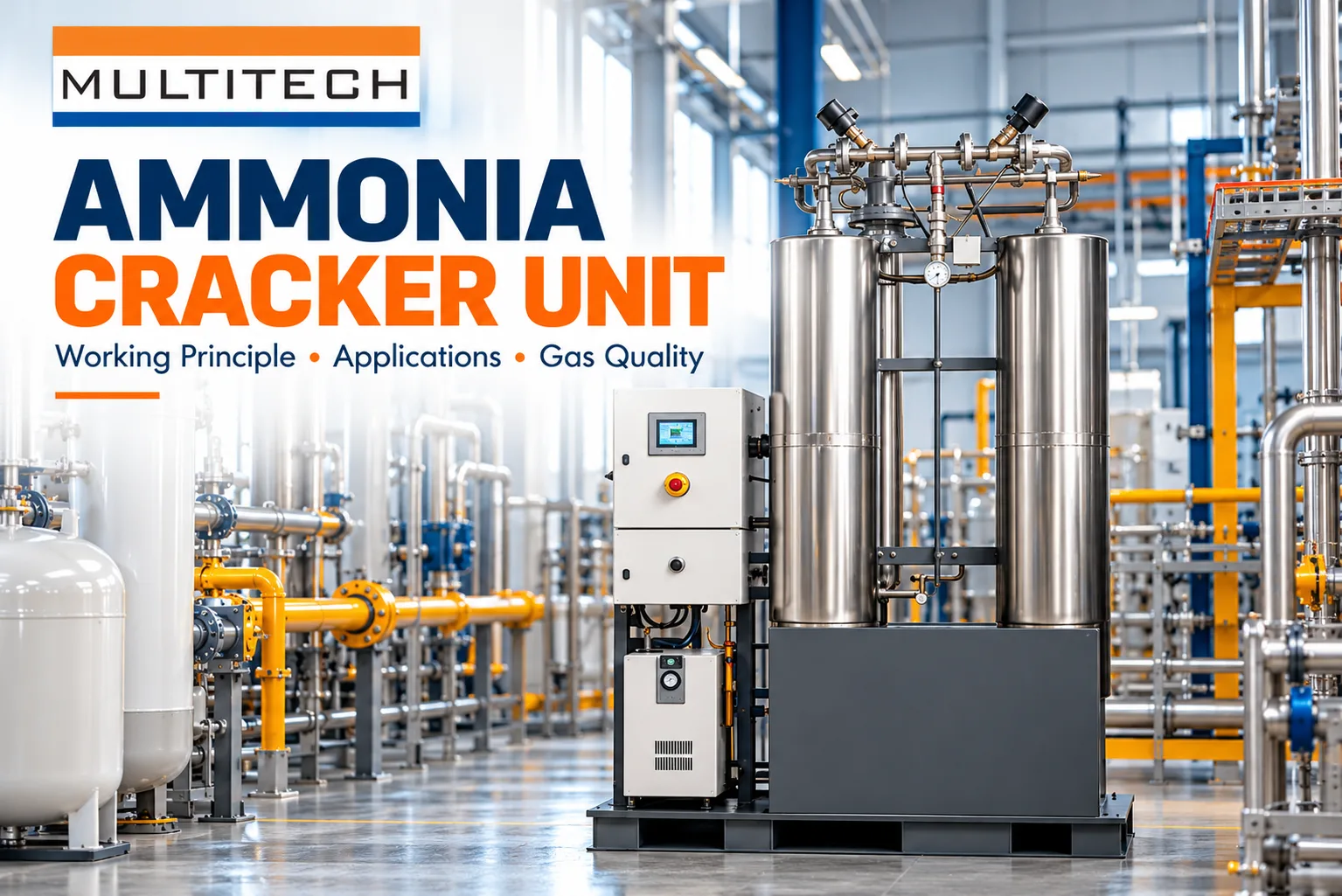
An ammonia cracker unit converts anhydrous ammonia into a hydrogen-rich gas by heating it over a catalyst. The reaction produces a mixture that is typically used as a reducing or protective atmosphere in heat treatment, brazing, sintering and selected metal-processing operations. The equipment is not simply a hydrogen generator: storage, vaporisation, temperature control, catalyst condition, purification, pressure regulation and safe venting determine whether the delivered gas is suitable for the process.
Selection should start with the required gas flow, composition, dew point, residual ammonia, pressure, duty cycle and end-use risk. Buyers should then define the battery limits, utilities, hazardous-area requirements, monitoring, shutdown philosophy and acceptance tests. A unit that meets only a flow figure may still fail the process if purity, stability or safety controls are unclear.
How the Ammonia Cracking Reaction Works
In the cracking chamber, gaseous ammonia passes over a heated nickel-based catalyst. Under controlled high-temperature conditions, ammonia dissociates into hydrogen and nitrogen. The theoretical dry product contains hydrogen and nitrogen in a three-to-one volume relationship, but actual outlet quality depends on conversion efficiency, temperature stability, catalyst performance, feed quality and any downstream cleanup.
The reaction is endothermic, so the furnace or electric heating system must supply and regulate heat continuously. Low temperature, uneven heating, excessive flow or degraded catalyst can increase uncracked ammonia. Operators therefore need reliable temperature measurement, interlocks and a controlled start-up sequence before product gas is admitted to the user process.
Map the Complete Process Flow
A practical system may include ammonia storage interface, pressure reduction, vaporiser, feed controls, heated retort, catalyst bed, gas cooling, moisture or ammonia removal, receiver or buffer arrangement, pressure control, analysers and distribution piping. The exact scope varies, so the proposal should show every component and the physical battery limit.
MultiTech presents its ammonia cracker unit range for industrial hydrogen generation. Use that product context to begin discussion, then request a process flow diagram, equipment list, control narrative, utility schedule and documented outlet-gas guarantee for the selected configuration.
| Design input | What to define | Why it matters |
|---|---|---|
| Gas demand | Normal, peak and turndown flow | Unit size and stability |
| Gas quality | Composition, dew point and residual ammonia | Process results and safety |
| Delivery | Pressure, buffer volume and distance | Distribution performance |
| Duty | Hours, starts and standby philosophy | Heating and lifecycle cost |
| Site | Ventilation, classification and ambient conditions | Installation design |
| Utilities | Power, cooling, instrument air and drains | Operating readiness |
| Acceptance | Tests, instruments and tolerances | Commercial clarity |
Define Gas Quality Before Capacity
Capacity should never be specified without quality. A process using cracked gas for bright annealing may be sensitive to moisture, oxygen and residual ammonia, while another application may tolerate wider limits. State quality at a defined flow, pressure and operating condition and identify whether the value applies at the cracker outlet or after purification.
Agree the measurement method, analyser range, calibration gas, sample point and stabilisation time. If a dryer, purifier or polishing stage is needed, include its inlet assumptions, regeneration method, consumables and bypass philosophy. Apparent low pricing often reflects a different scope rather than an equivalent unit.
Size the Unit for Real Demand
Develop an hourly demand profile rather than adding nameplate consumption figures. Include furnace charging cycles, purge demand, simultaneous users, expansion and unavoidable distribution losses. Oversizing can cause poor turndown and unnecessary thermal loss; undersizing can lower pressure or interrupt the protective atmosphere during peak demand.
Where demand is intermittent, evaluate buffer storage and the safe operating range of the downstream process. Consider whether one unit, duty-standby units or staged capacity gives better continuity. The final choice should account for maintenance windows, catalyst service and the consequence of losing gas during production.
Choose the Heating and Retort Arrangement
Electric heating offers controllability and may simplify some installations, while other furnace arrangements can be evaluated where utilities and project standards allow. The retort, insulation and heater design must deliver uniform catalyst temperature without exposing materials to unacceptable stress. Thermal expansion, seals and supports require careful engineering.
Ask for rated power, heat-up time, temperature zones, control accuracy, insulation details and expected external surface conditions. Confirm how heater or thermocouple failure is detected and repaired. MultiTech also describes broader industrial gas and compressor solutions, which can help buyers coordinate utilities without assuming that every accessory is included in the cracker package.
Understand Catalyst Performance and Replacement
Catalyst performance depends on temperature, feed cleanliness, flow distribution and operating history. Contamination, thermal cycling or prolonged operation outside the specified range can reduce conversion. The supplier should state catalyst type, loading, expected service conditions and the indicators used to decide replacement.
Plan safe removal, handling and disposal or return of spent catalyst. Keep operating trends for temperature, flow and gas analysis so deterioration is detected before product quality is affected. A fixed calendar interval is less useful than a condition-based decision supported by validated measurements and supplier guidance.
Control Feed Ammonia and Vaporisation
Stable gaseous feed is essential. Define allowable ammonia quality, storage pressure, vaporiser capacity, pressure regulation, filtration and protection against liquid carryover. Cold weather, high withdrawal rates or inadequate storage can reduce vaporisation and destabilise the cracker even when the core unit is correctly sized.
Coordinate storage and unloading with applicable safety requirements, emergency isolation, leak detection and operator procedures. Confirm whether the supplier scope begins at a gas connection or includes storage and vaporisation. This boundary materially changes project cost and responsibility.
Engineer Safety as a System
Ammonia is toxic and corrosive, while hydrogen is highly flammable and can ignite over a wide concentration range. The design must address ventilation, detection, compatible materials, relief, safe discharge, electrical classification, ignition control, bonding, earthing, access and emergency response. Applicable statutory and site requirements must be confirmed by competent professionals.
Interlocks should move the unit to a defined safe state during loss of power, low temperature, abnormal pressure, flame or heater fault, inadequate ventilation or detected leakage as applicable. Do not bypass a trip to maintain production. Record cause, corrective action and restart authorisation.
Plan Controls Alarms and Shutdowns
The control system should manage warm-up, feed admission, temperature, gas routing, purging, shutdown and cooldown. Operators need clear indication of permissives, trip causes and process status. Remote monitoring can support maintenance, but essential protection should not depend on an unreliable network connection.
Request an alarm and trip matrix with set points, delays, voting where used and reset conditions. Define manual mode carefully so it cannot defeat safety functions. Back up controller programs and retain revision-controlled logic, drawings and instrument settings at handover.
Design Distribution and Point-of-Use Protection
Cracked gas piping should be sized for flow and pressure drop using compatible materials and approved joining methods. Prevent air ingress, uncontrolled cross-connections and dead legs. Provide isolation, non-return protection, purging points and safe venting according to the final process design.
At each user, assess pressure regulation, flow monitoring and interlocks with the furnace or process. A loss of protective gas may require an automatic safe action. Long distribution networks need leak testing and may justify local buffering or monitoring so a central outlet reading does not mask point-of-use conditions.
Match the Unit to Industrial Applications
Heat treatment and bright annealing use cracked ammonia atmospheres to limit oxidation and support desired surface conditions. Brazing, sintering and certain furnace operations may also use hydrogen-nitrogen mixtures. Suitability depends on material, temperature, furnace type, product specification and site safety rules.
Do not market the gas as universally appropriate. Process specialists should confirm whether composition, dew point and residual contaminants meet the metallurgical requirement. Trial results on representative products may be needed before full production acceptance.
Compare Ammonia Cracking with Other Supply Options
Compare on-site cracking with delivered hydrogen, nitrogen-hydrogen blending and other on-site generation routes. Evaluate gas specification, consumption, logistics, site restrictions, capital cost, energy, maintenance, storage risk, redundancy and future demand. The lowest cost per unit of nominal gas may not produce the lowest process risk.
A lifecycle comparison should use the same pressure, purity, availability and battery limits. Include ammonia storage and compliance costs, power demand, catalyst, analysers, planned service and production loss during outage. Document assumptions so alternatives are genuinely comparable.
| Option factor | Question for the buyer | Evidence |
|---|---|---|
| Performance | Will gas quality remain stable at peak and turndown? | Guaranteed data and test plan |
| Safety | Which hazards and statutory controls apply? | Risk assessment and design basis |
| Availability | How is production protected during maintenance? | Redundancy and service plan |
| Utilities | What power, ventilation and cooling are needed? | Utility schedule |
| Lifecycle | What consumables and inspections recur? | Cost and maintenance schedule |
| Scope | Where are storage and distribution boundaries? | Responsibility matrix |
Commission with Defined Acceptance Tests
Pre-commissioning should confirm mechanical completion, pressure testing, electrical checks, instrument calibration, ventilation, detectors, relief paths, controls and interlocks. Start-up should follow the approved sequence with competent supervision and controlled gas routing.
Measure capacity, pressure, composition, dew point and residual ammonia at agreed conditions. Demonstrate alarms, trips, restart logic and operating modes without creating unsafe tests. Record instruments, calibration status, ambient conditions and tolerances in the signed acceptance report.
Operate and Maintain with Trend Data
Routine work may include leak checks, analyser verification, filter and purifier service, heater and thermocouple inspection, pressure-control checks, detector tests and catalyst assessment. Frequency should follow risk, manufacturer instructions, duty and site experience.
Trend temperature profile, flow, pressure, power and gas quality. Gradual changes can reveal catalyst decline, feed instability or heat-transfer problems before an off-spec event. MultiTech’s About Us pagenotes installation training and after-sales support; the contract should state the specific training, response and spare-part commitments.
Procurement Checklist for an Ammonia Cracker Unit
Issue a clear datasheet covering feed, outlet specification, capacity profile, pressure, ambient conditions, utilities, materials, controls, hazardous-area requirements, documents, tests, commissioning and warranties. Ask bidders to list deviations and exclusions rather than hiding them in general terms.
Review process calculations, drawings, certifications, inspection plans and service capability with the operations and safety teams. Confirm that the supplier has not assumed site systems that do not exist. Freeze the approved model and scope before fabrication.
Common Buying and Operating Mistakes
Common mistakes include sizing only on average demand, accepting undefined gas purity, ignoring storage and vaporisation, omitting ventilation or detectors, and comparing packages with different battery limits. Another is sending product gas to the process before temperature and analysis have stabilised.
Avoid unsupported claims about energy, catalyst life or maintenance. MultiTech’s manufacturer overview provides supplier context, but project decisions should be based on the approved technical offer, risk review and acceptance evidence.
Verify Materials Compatibility and Fabrication Quality
Review the compatibility of piping, valves, seals, vessels and instrument wetted parts with ammonia and hydrogen service at the stated pressure and temperature. Material selection should be documented, not inferred from a general equipment brochure. Fabrication procedures, welding qualifications and nondestructive examination should match the approved design basis.
Inspect cleanliness, identification, supports, insulation and access before dispatch. Ask for material records, pressure-test results and inspection release. A compact skid is useful only when valves, analysers and heaters remain safely accessible for operation and service.
Control Moisture and Residual Ammonia
Moisture and residual ammonia can affect furnace atmosphere, product finish and downstream equipment. Establish the required limit and the sampling condition, then determine whether cooling, separation, adsorption or another purification stage is necessary. The cleanup system should be sized for the complete flow and expected inlet condition.
Specify regeneration or replacement intervals, differential-pressure monitoring and disposal of spent media. Provide a safe response when the analyser indicates off-specification gas. Routing unsuitable gas into production to avoid downtime can create greater quality loss and safety risk.
Plan Start-Up Shutdown and Purging
Start-up requires controlled heating, leak checks, purging and confirmation that the catalyst zone is stable before ammonia feed and product delivery. The exact sequence must be supplied and validated for the installed system. Operators need clear hold points and permissives rather than relying on memory.
Shutdown should isolate feed, protect equipment and leave the system in a defined safe condition. Emergency shutdown may differ from planned cooldown. Identify purge-gas source, volume and discharge route, and include abnormal recovery in training and drills.
Assess Energy and Operating Cost
Major operating costs can include heating power, ammonia, purification consumables, analyser gases, maintenance and planned downtime. Calculate consumption at normal and reduced demand, because a thermally maintained unit may use significant energy even when product flow falls.
Use measured or guaranteed values under stated conditions. Compare annual cost with the production schedule and process value, not just equipment efficiency. Heat loss, insulation condition and repeated cold starts should be considered in the operating strategy.
Prepare Spares and Service Capability
Identify critical heaters, thermocouples, control components, seals, valves, analyser parts and catalyst-related items. Determine which failures stop production and which items have long lead times. Initial spares should reflect consequence and availability rather than a generic percentage of purchase price.
Agree remote support, site response, preventive visits and commissioning assistance. Keep drawings and logic backups accessible to authorised maintenance staff. Service work involving ammonia or hydrogen needs competent personnel, isolation and gas-free confirmation.
Conduct Periodic Performance Reviews
Repeat gas-quality and capacity checks at defined intervals and after major maintenance. Compare results with commissioning baselines and review trips, leaks, energy use, catalyst indicators and process complaints. A stable outlet number alone may hide deteriorating heaters or controls.
Use the review to update maintenance frequency, spare holdings and operator training. Where demand or downstream equipment changes, reassess capacity and distribution before increasing feed. Controlled engineering change is safer than incremental field adjustment.
Frequently Asked Questions
1. What does an ammonia cracker unit produce?
It produces a hydrogen-rich mixture with nitrogen by catalytically dissociating ammonia under controlled heat.
2. What is the normal hydrogen-to-nitrogen relationship?
The theoretical dry product has hydrogen and nitrogen in a three-to-one volume relationship, subject to conversion and cleanup.
3. Why is outlet quality important?
Moisture, residual ammonia, oxygen and unstable composition can affect safety, furnace atmosphere and product quality.
4. How is capacity selected?
Use normal, peak and turndown demand, operating hours, distribution losses, expansion and required redundancy.
5. Is purification always required?
Not always. It depends on the permitted dew point, residual ammonia and contaminant limits of the end process.
6. What utilities are commonly needed?
Power is normally essential; requirements for cooling, ventilation, instrument air and drains depend on configuration.
7. How is catalyst condition monitored?
Track conversion quality, residual ammonia, temperature profile, pressure and operating history against supplier guidance.
8. Can cracked ammonia be used for every furnace?
No. A process specialist must confirm gas quality and suitability for the material, furnace and product requirement.
9. What safety systems are important?
The design may require ventilation, gas detection, relief, isolation, interlocks, compatible materials and emergency procedures.
10. What should an RFQ include?
Include feed conditions, gas specification, flow profile, pressure, site data, utilities, controls, tests and scope boundaries.
11. How should commissioning be accepted?
Witness documented tests for capacity, quality, pressure, controls, interlocks and safe operating modes.
12. What documents should be handed over?
Request approved drawings, manuals, logic, certificates, test reports, spare lists, maintenance schedules and training records.
Build a Safer Ammonia Cracking System Around the Real Process Demand
An ammonia cracker unit delivers value only when gas demand, purity, pressure, dew point, safety, utilities and downstream use are engineered together. Share the required flow, operating schedule, process application, delivery pressure, available utilities, site conditions and quality expectations through the MultiTech contact channel. Ask for a documented proposal covering the process basis, equipment scope, controls, testing, commissioning and lifecycle support rather than comparing units only by nominal capacity.





-
Vacuum Pump Maintenance Checklist for Industrial Applications
-

Liquid Ring Vacuum Pump: Applications and Selection Factors
-

Vacuum Pump Price in India: Complete Buying Guide
-

Air Compressors for Automotive Manufacturing Capacity and Selection Guide
-
Nitrogen Generator for Food Packaging: Purity and Capacity Requirements


