Nitrogen Generator for Food Packaging: Purity and Capacity Requirements
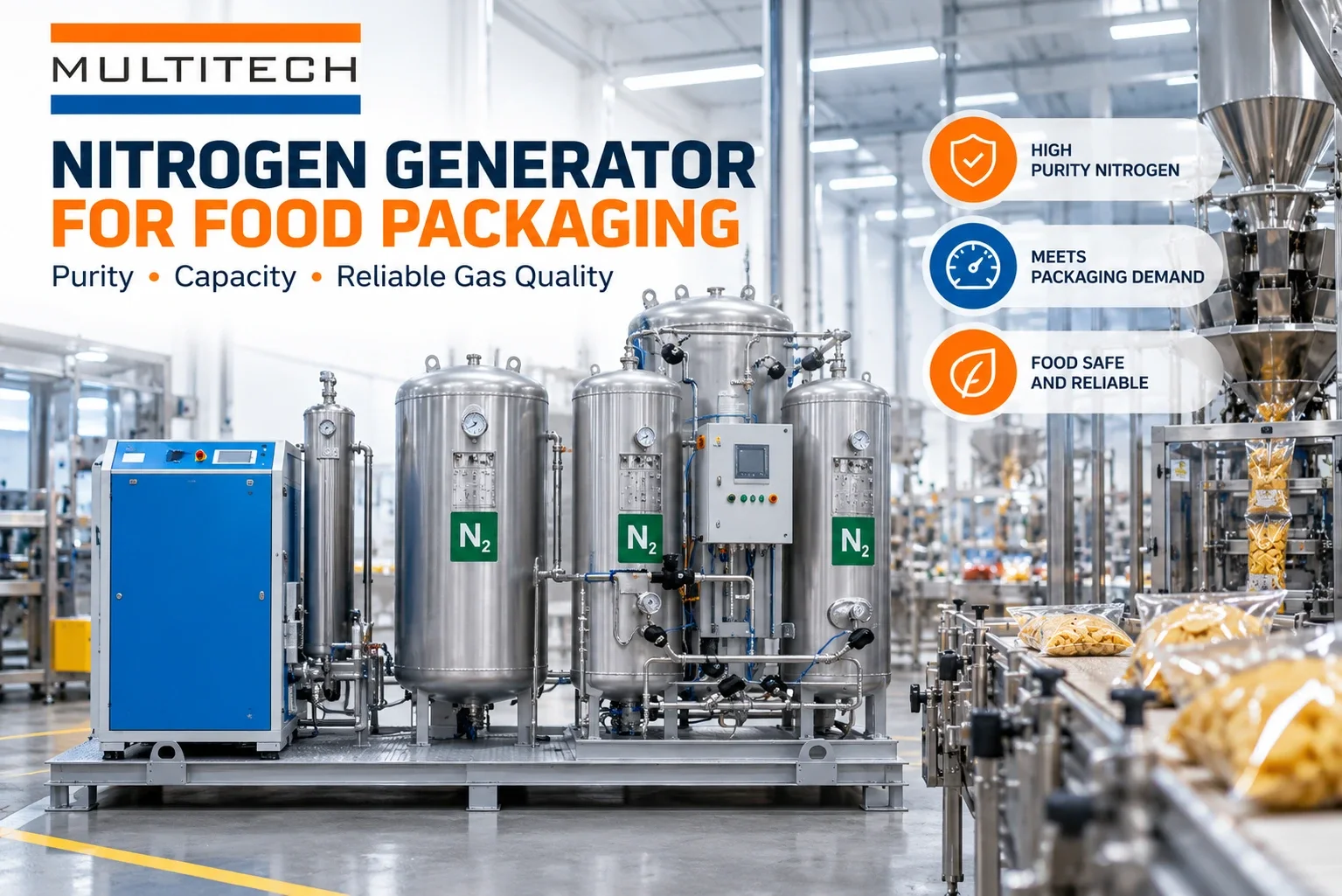
A nitrogen generator for food packaging should be selected from the product and packaging process, not from a generic purity number. Define why nitrogen is used, the acceptable residual oxygen, pack rate, gas dose, operating pressure, peak and average demand, hours of operation, food-contact controls and planned growth. Then size generation, compressed-air treatment, buffers, distribution and monitoring as one system.
For many operations, the best design is the lowest verified nitrogen specification that consistently protects product quality through the stated shelf life. Excessive purity can increase compressed-air consumption and plant size without improving the pack. Insufficient capacity or unstable pressure can interrupt sealing and raise residual oxygen. Use product trials, packaging-machine data and a documented acceptance test before purchase.
| Selection input | What to define | Why it matters |
|---|---|---|
| Product and pack | Food sensitivity, pack volume, film and target shelf life | Sets the gas objective |
| Gas quality | Nitrogen purity, oxygen, dew point and contaminants | Protects product and process |
| Demand | Average, peak, batch and future flow | Sets generator and buffer size |
| Utilities | Feed-air pressure, quality, power and cooling | Determines reliable output |
| Verification | Sampling, alarms, records and acceptance test | Proves performance |
Start with the Food and Shelf-Life Objective
Clarify whether nitrogen is intended to displace oxygen, limit oxidation, reduce rancidity, protect flavour, slow colour change, support a fragile pack or create an inert headspace. The requirement differs for snacks, nuts, coffee, powders, dairy ingredients and other foods. Nitrogen does not replace hygienic processing, temperature control, seal integrity or validated shelf-life work. It is one control within the complete package system.
Record product moisture, oil content, oxygen sensitivity, storage temperature, expected distribution time, package material and seal method. Use trials to compare residual oxygen and quality at defined intervals. A technical supplier can size equipment, but the food business owns the product specification and evidence. Avoid borrowing a purity target from an unrelated food simply because it appears conservative.
Translate Residual Oxygen into a Nitrogen Specification
The nitrogen purity stated at the generator is not the same as residual oxygen measured inside a sealed pack. Air trapped in the product, leaks, film permeability, machine timing and gas mixing all influence the final pack. First define an acceptable residual-oxygen range and sampling method. Then determine the nitrogen quality needed at the packaging-machine inlet under normal and worst-case operation.
Higher purity is not automatically better. Pressure-swing adsorption output, recovery and compressed-air demand change as purity becomes more stringent. Select the least demanding specification that passes product and shelf-life validation, while leaving a controlled operating margin. State purity as a measurable value, identify the sample point and define how off-spec gas is diverted or the line is stopped.
Understand PSA and Membrane Generation Options
Pressure-swing adsorption systems use adsorbent vessels that alternate between production and regeneration to separate nitrogen from compressed air. Membrane systems separate gases through selective permeation and can suit applications where moderate purity, simplicity or variable demand is important. Cryogenic supply may be relevant at very large scale, but it is a different plant and logistics decision. Technology must follow the application range rather than marketing preference.
Multitech lists on-site nitrogen gas generation systems using PSA, membrane and cryogenic approaches, with food processing among the stated applications. Ask for performance at your specified purity, inlet-air condition, ambient range and pressure. Compare usable product flow, not the largest headline flow at a lower purity or ideal test condition.
Calculate Average Nitrogen Demand from the Packaging Process
Obtain gas-consumption data from the packaging-machine manufacturer and verify it in production. For gas flushing, demand depends on pack volume, displacement ratio, nozzle arrangement, dwell time, line speed and leakage. Tray sealing or modified-atmosphere processes may use evacuation, gas replacement or both. Include purge gas used during start-up, changeovers and sanitation where applicable.
Build demand by line and format. Multiply the verified dose per pack by packs per minute, then convert to the same reference conditions used by the generator supplier. Add steady uses such as hopper blanketing only when they operate simultaneously. Do not size from floor area or total machine electrical load. Record normal, minimum and campaign demand so controls can operate efficiently across the range.
Size for Peak Flow, Not Only Daily Consumption
A daily nitrogen total can hide short periods when several machines draw gas together. The generator may meet average consumption yet pressure collapses during synchronized flushes. Map demand in seconds and minutes as well as hours. Identify the highest credible combination of lines, start-up purges and manual uses, then distinguish instantaneous peak flow from sustained peak production.
A receiver or product-gas buffer can cover brief peaks if its usable volume, pressure band and recovery time are calculated. Long production peaks require generation capacity, not an oversized vessel. Confirm how the system responds when pressure falls, purity drifts or demand exceeds rating. A capacity statement should show continuous flow at specification plus the peak-handling strategy and operating reserve.
| Demand element | Data source | Sizing treatment |
|---|---|---|
| Pack flush | Machine trial or manufacturer data | Dose × packs per minute |
| Line start-up | Observed purge duration and flow | Short-duration peak |
| Multiple lines | Production schedule | Simultaneous demand |
| Blanketing | Flowmeter or process design | Continuous or batch load |
| Growth | Approved capacity plan | Defined future margin |
Set a Defensible Design Margin
Margin should cover measurement uncertainty, seasonal conditions, filter ageing, minor leakage and an approved production increase. It should not conceal missing data. Excessive oversizing can increase capital, inefficient cycling and maintenance, while too little margin leaves no recovery after a demand spike. Show the base demand, each allowance and the final selected capacity so future users understand the decision.
Where production varies, consider turndown, modular generation or staged operation. Ask how purity and efficiency behave at low load and during starts. If a second production line is only a future possibility, define the connection, space, electrical and compressor provisions now without necessarily buying all capacity. A transparent margin is easier to review than an unexplained percentage added to every assumption.
Check the Compressed-Air Supply as Part of the System
PSA and membrane generators depend on stable compressed air. Measure pressure, temperature, flow and dew point at representative production conditions. Account for compressor loading, pressure drop through treatment and other plant users. A generator cannot deliver its rated nitrogen if feed pressure falls or the available compressor flow is already committed. Review compressor redundancy and the consequence of a single utility failure.
Multitech’s industrial product range includes compressors, dryers, filters and gas-generation equipment. For the project, request a unified mass balance showing feed-air consumption for each nitrogen purity and flow point. Include purge losses, dryer regeneration and pressure drops. The proposal should state whether existing compressors are adequate or what additional capacity is required.
Specify Feed-Air Drying and Filtration
Oil, water, particles and excessive temperature can damage adsorbent, membranes, valves and downstream food operations. Define compressor type, aftercooling, condensate separation, filtration and dryer performance from the generator manufacturer’s inlet limits and site conditions. Provide automatic drains and differential-pressure indication where appropriate. Food businesses should also assess odour, aerosol and microbiological risks at relevant interfaces.
Multitech describes compressed-air filtration equipment and a heatless desiccant dryer range. These are contextual options, not a universal treatment train. Select components through measured inlet quality, required dew point, pressure loss and maintenance capability. Place sampling points before and after critical treatment stages.
Define Nitrogen Quality Beyond Percentage Purity
A complete gas specification may address oxygen concentration, pressure dew point, oil aerosol or vapour, particles, odour and other contaminants relevant to the food and process. Purity alone describes the nitrogen-to-other-gases relationship but does not prove the gas is clean, dry or suitable at the point of use. Align limits with risk assessment, customer requirements and applicable food-safety controls.
Document materials in contact with product gas, receiver condition, piping cleanliness and commissioning purge. Use suitable filters only where their purpose and maintenance are defined. If sterile filtration or microbiological control is required, validate the arrangement for the real system rather than assuming any fine filter creates sterile gas. Establish change intervals and integrity checks from evidence and manufacturer guidance.
Plan Product-Gas Storage and Distribution
Size the nitrogen receiver for peak support, purity stabilization and controlled recovery. State vessel design pressure, usable pressure range, drainage or inspection provisions and applicable statutory requirements. Distribution piping should be compatible, clean, correctly sized and protected from contamination. Excess pressure drop at the farthest machine can produce poor flushing even when the generator outlet looks normal.
Map line lengths, fittings, regulators, isolation valves and future branches. Avoid dead legs where cleanliness matters. Label the system and prevent cross-connection with compressed air or other gases. Provide local pressure indication at critical packaging lines. If high-pressure storage or boosters are proposed, treat them as separate engineered systems with additional safety, energy and maintenance requirements.
Instrument Purity, Pressure and Flow
Use an oxygen analyser suitable for the target range and locate its sample so it represents delivered nitrogen. Define warm-up, calibration, sample conditioning and response time. Add pressure and flow measurement that can distinguish generator performance from distribution problems. Trend values through start-up, peak demand and shutdown. An analyser display without calibration or alarm action does not provide reliable control.
Agree alarm and interlock logic: warning, off-spec diversion, packaging-line stop or controlled fallback. Prevent off-spec gas produced during start-up from entering finished packs. Retain records at a frequency consistent with the food-safety plan and customer requirements. Assign responsibility for sensor calibration, calibration-gas management and investigation of excursions. Operators need simple instructions for what each alarm means.
Validate the Generator with Packaging Trials
Factory testing should verify equipment capacity at stated inlet and outlet conditions. Site acceptance should then confirm performance with actual compressors, treatment, piping and packaging machines. Test normal load, credible peak, low-load operation, restart after shutdown and alarm response. Measure nitrogen purity, flow, pressure and dew point where specified, plus residual oxygen in representative finished packs.
Shelf-life validation may continue after equipment handover because product quality develops over time. Define provisional and final acceptance separately. Capture pack format, film, line speed, gas settings, product temperature and sampling location so results are repeatable. Do not approve the system solely because the generator reaches purity with no packaging demand connected.
| Acceptance check | Evidence | Pass basis |
|---|---|---|
| Generator output | Calibrated purity, flow and pressure readings | Specified continuous point |
| Peak response | Pressure and purity trend | No unacceptable excursion |
| Pack performance | Residual-oxygen samples by format | Validated operating range |
| Controls | Alarm, diversion and recovery test | Approved cause-and-effect |
| Documents | Drawings, certificates and calibration records | Complete handover |
Build Reliability and Backup Around Production Risk
Define the allowed packaging downtime and cost of lost production. A low-risk, single-shift line may accept planned maintenance windows, while continuous high-volume packaging may need standby capacity, modular generators, stored nitrogen or a verified external supply connection. Redundancy should cover the credible failure, which may be the compressor, dryer, analyser, valve or power supply rather than the generator vessel alone.
Create a changeover procedure and periodically test it. Store only the amount and pressure justified by risk, with suitable safety controls. Critical spares may include valve kits, filter elements, analyser consumables and control components. Ask the supplier for realistic service response and parts lead times. A standby system that cannot connect at the correct pressure or purity is not useful resilience.
Plan the Equipment Room and Safety Controls
Provide a dry, ventilated and accessible location with safe maintenance clearances, lifting routes, lighting, drainage and protection from impact. Review equipment noise and heat rejection. Keep air intakes away from contaminated exhausts and position vessels, valves and electrical panels for inspection. The layout should allow filter changes and adsorbent or membrane service without dismantling unrelated production equipment.
Nitrogen is non-flammable but can displace oxygen in an enclosed space. Assess asphyxiation risk, ventilation, gas release points, confined areas and emergency response. Label lines and vessels, restrict unauthorized adjustments and apply applicable pressure-system and electrical requirements. Train operators to treat a low-oxygen alarm or suspected leak as a safety event, not merely a packaging fault.
Compare Lifecycle Cost on the Same Operating Basis
Compare capital, compressor power, dryer losses, maintenance, adsorbent or membrane life, calibration, spares, receiver inspection, floor space and backup supply. Use the same nitrogen purity, flow profile, operating hours, electricity tariff and growth case for every option. Do not compare an on-site system at one specification with cylinder or liquid supply at another without accounting for delivered gas and handling.
Calculate sensitivity to demand and purity because compressed-air consumption can dominate operating cost. Include compressor replacement if existing capacity is insufficient. Avoid guaranteed savings without verified baseline invoices and utility measurements. A lifecycle model should make assumptions visible and show who bears performance risk. Review actual energy and gas use after commissioning against the design model.
Maintain Food-Safe Performance Over Time
Create preventive tasks for compressors, drains, filters, dryers, generator valves, adsorbent or membranes, analysers, receivers and distribution. Trend feed-air and nitrogen conditions so degradation is found before packs fail. Inspect leaks and pressure drop. Use approved parts and record any control-setting changes. Maintenance that bypasses treatment or alarms can invalidate the food-safety control.
Multitech’s company profile describes application-oriented compressed-air and gas equipment support. Contract the specific training, preventive visits, response times and performance checks required by your plant. Keep manuals, drawings, calibration records, spares lists and troubleshooting steps accessible. Revalidate after major recipe, film, machine-speed or distribution changes.
Frequently Asked Questions
1. Why is nitrogen used in food packaging?
It can displace oxygen, reduce oxidation and support pack integrity, but it does not replace hygiene, sealing, temperature control or shelf-life validation.
2. What nitrogen purity is required for food packaging?
There is no universal value. Select purity from product trials, residual-oxygen targets, packaging method and validated shelf-life performance.
3. Is generator purity the same as pack residual oxygen?
No. Trapped air, flushing efficiency, film, leaks and machine settings affect oxygen inside the finished pack.
4. How is generator capacity calculated?
Use verified gas dose, pack rate, simultaneous lines, continuous uses, start-up purges, peak duration and a transparent operating margin.
5. Can a receiver cover peak demand?
It can cover calculated short peaks, but sustained demand must be met by generation capacity and feed-air supply.
6. Does a PSA nitrogen generator need a compressor?
Yes. It needs compressed air at the stated flow, pressure, temperature and cleanliness, including treatment losses.
7. What air treatment is normally needed?
Treatment is selected from inlet-air condition and generator limits and may include cooling, separation, filtration and drying.
8. How should nitrogen quality be monitored?
Use calibrated oxygen analysis plus relevant pressure, flow, dew-point and contaminant checks at defined sample points.
9. What happens during off-spec nitrogen?
A documented alarm and control sequence should warn, divert gas, stop packaging or start backup according to product risk.
10. Should the system have backup nitrogen?
Use production downtime risk to decide between standby generation, stored gas or a verified external supply connection.
11. How is a nitrogen generator accepted?
Test continuous and peak performance, controls, gas quality and representative finished packs under documented site conditions.
12. Can one generator serve several packaging lines?
Yes, if simultaneous demand, pressure drop, isolation, peak flow and expansion are engineered and verified.
Build a Verified Nitrogen Supply Around Your Packaging Line
A well-selected system provides the right gas quality at the real peak demand, with enough storage, treatment and monitoring to keep packaging stable. Share your products, pack formats, machine gas-consumption data, residual-oxygen target, required pressure, production schedule, compressed-air survey and expansion plan with Multitech through the nitrogen system enquiry page. Request a documented proposal covering design basis, air treatment, usable capacity, controls, tests, maintenance and operating assumptions.