How to Choose the Right Industrial Air Compressor for Your Factory
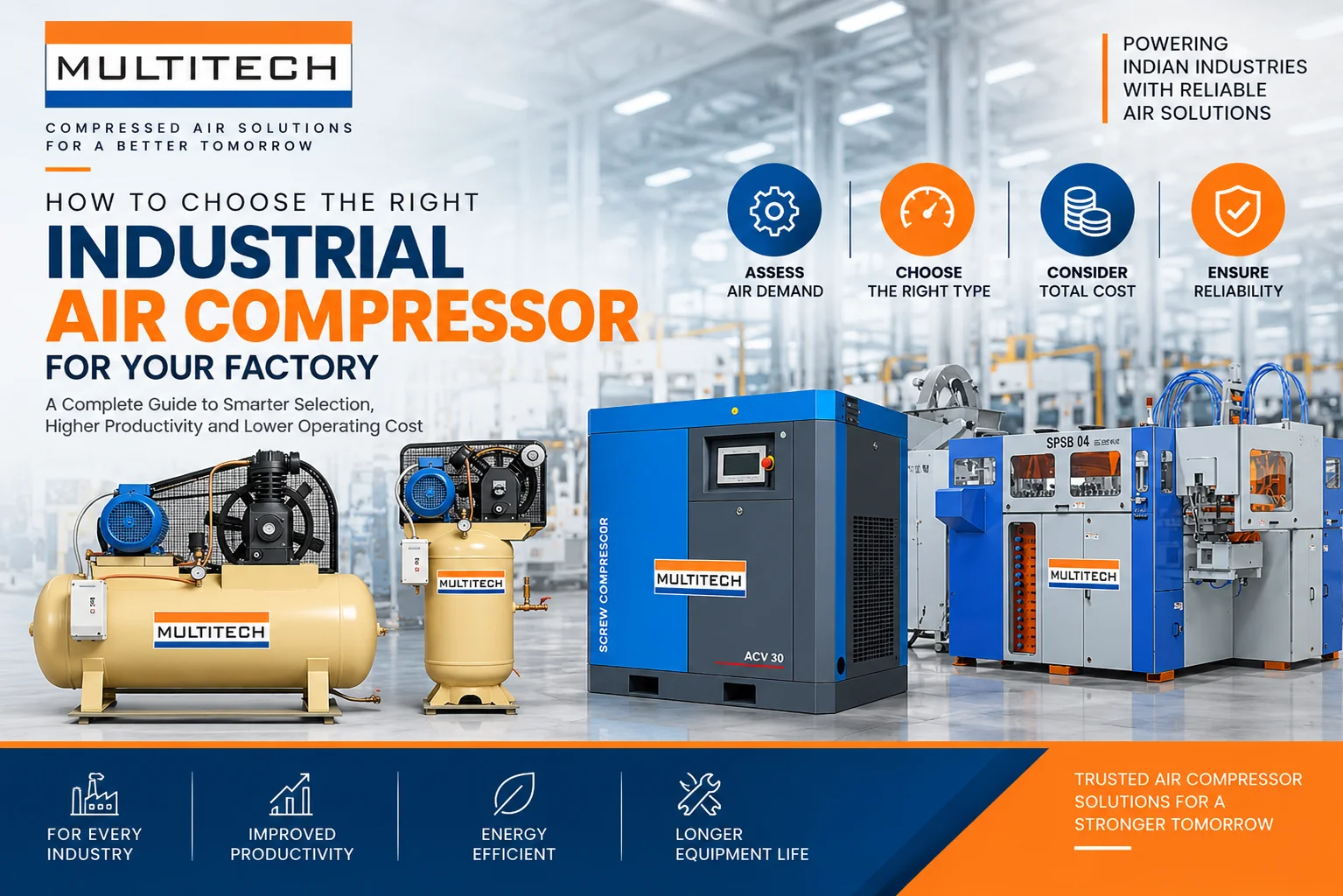
The right industrial air compressor is the one that delivers the required free air delivery at the required working pressure, for the factory’s actual duty cycle, while meeting its air-quality and reliability needs. Begin with measured air demand and pressure. Then compare compressor type, controls, dryer, receiver, filters, installation and service support as one system.
Buying by horsepower alone is risky. A 20 HP compressor from one design may deliver a different flow from another, and a machine that appears powerful on paper may fail to maintain pressure when several production points run together. Good industrial air compressor selection connects the machine to the work it must perform.
Why compressor selection affects production
Compressed air is used across many factories for pneumatic tools, cylinders, valves, packaging equipment, cleaning systems, instrumentation and process machinery. When pressure falls, the symptoms may appear as slower actuators, inconsistent tool performance, rejected products or unplanned stops. When the system is oversized, the plant may pay for unnecessary motor capacity and inefficient part-load running.
The compressor works with the air network around it. Intake conditions, room temperature, receiver volume, pipe diameter, leaks, drains, filters and dryers all influence usable air at the point of use. The selection decision should therefore be made as a complete compressed-air system, not as an isolated equipment purchase.
Factories in the Faridabad and wider NCR manufacturing belt often operate mixed production lines, where demand changes by shift and product. A clear requirement sheet helps a manufacturer quote a suitable package and helps procurement compare offers fairly. Multitech Compressors is based in Faridabad and supplies compressor solutions across India; its [Our Presence page](https://www.multitechcompressors.com/our-presence) can support location and supply discussions.
What is industrial air compressor selection
Industrial air compressor selection is the process of matching a compressor and its supporting equipment to a factory’s required airflow, working pressure, operating hours, air quality, environment, control pattern and future expansion. It considers both purchase cost and the energy, maintenance and downtime costs created by the choice.
In practical terms, selection answers five questions: How much air is needed? At what pressure? How clean and dry must it be? How often will the compressor run? Which configuration can deliver that performance reliably at the site?
Step 1 Calculate air demand before comparing models
List each machine and tool that will use compressed air. Record its consumption in CFM, l/min or m³/min, required pressure in bar, operating hours and whether it consumes air continuously or only during a cycle. Convert the values into one unit before adding them. Manufacturer data sheets are the best starting point, but field measurement is useful when actual demand differs from the design figure.
Add the demand of equipment that can operate at the same time. Do not simply add every connected machine if the production schedule makes simultaneous operation impossible. At the same time, do not use an average that hides a genuine peak. Production planning, shift patterns and future line additions should be included in the calculation.
| Demand item | What to record | Why it matters |
|---|---|---|
| Pneumatic tools | Flow, pressure, usage duration | Intermittent peaks can be high |
| Cylinders and actuators | Cycle rate and air volume | Demand follows machine speed |
| Packaging equipment | Continuous and peak flow | Pressure stability affects output |
| Instrumentation | Minimum pressure and air quality | Clean, dry air protects controls |
| Future expansion | Expected additional demand | Avoids immediate undersizing |
Step 2 Understand air compressor sizing
Air compressor sizing means selecting compressor capacity and pressure so the system meets demand without excessive energy use. The calculation should use free air delivery, or FAD, at the stated discharge pressure. FAD is more useful than a generic CFM label because it ties airflow to a defined operating condition.
A practical sizing approach is to calculate simultaneous demand, add a reasonable allowance for measured leakage and short-term growth, then compare that result with the compressor’s FAD at the required pressure. The allowance should be based on evidence. Oversizing by a large arbitrary percentage can create cycling, unloading losses and a higher capital cost.
Pressure is equally important. If the equipment requires 7 bar at the point of use, the compressor may need to produce slightly more to cover losses through filters, dryers, pipes, valves and elevation. Raising pressure far above the real requirement is not a substitute for correcting leaks or undersized piping. It increases energy consumption and may accelerate wear.
Step 3 Define compressor capacity correctly
Compressor capacity describes how much compressed air the machine can supply under specified conditions. It may be stated in CFM, m³/min or litres per minute. Always check whether the figure is inlet displacement, nominal capacity or FAD, and identify the pressure and test conditions attached to it.
Two compressors with the same 15 HP motor may not provide the same usable flow at 7 bar. Airend design, rotational speed, cooling, pressure setting and control method can change the result. Procurement teams should place FAD, working pressure, motor power and specific power side by side in the comparison sheet.
| Specification | Question to ask | Selection implication |
|---|---|---|
| FAD | What flow is delivered at the required pressure? | Confirms usable production air |
| Working pressure | What pressure is needed at the point of use? | Prevents unnecessary pressure margin |
| Motor power | What is the rated power and efficiency? | Affects electrical load |
| Duty cycle | Will it run continuously or intermittently? | Guides compressor type |
| Control method | How does it respond to changing demand? | Affects part-load energy use |
Step 4 Choose the compressor type
Reciprocating compressors
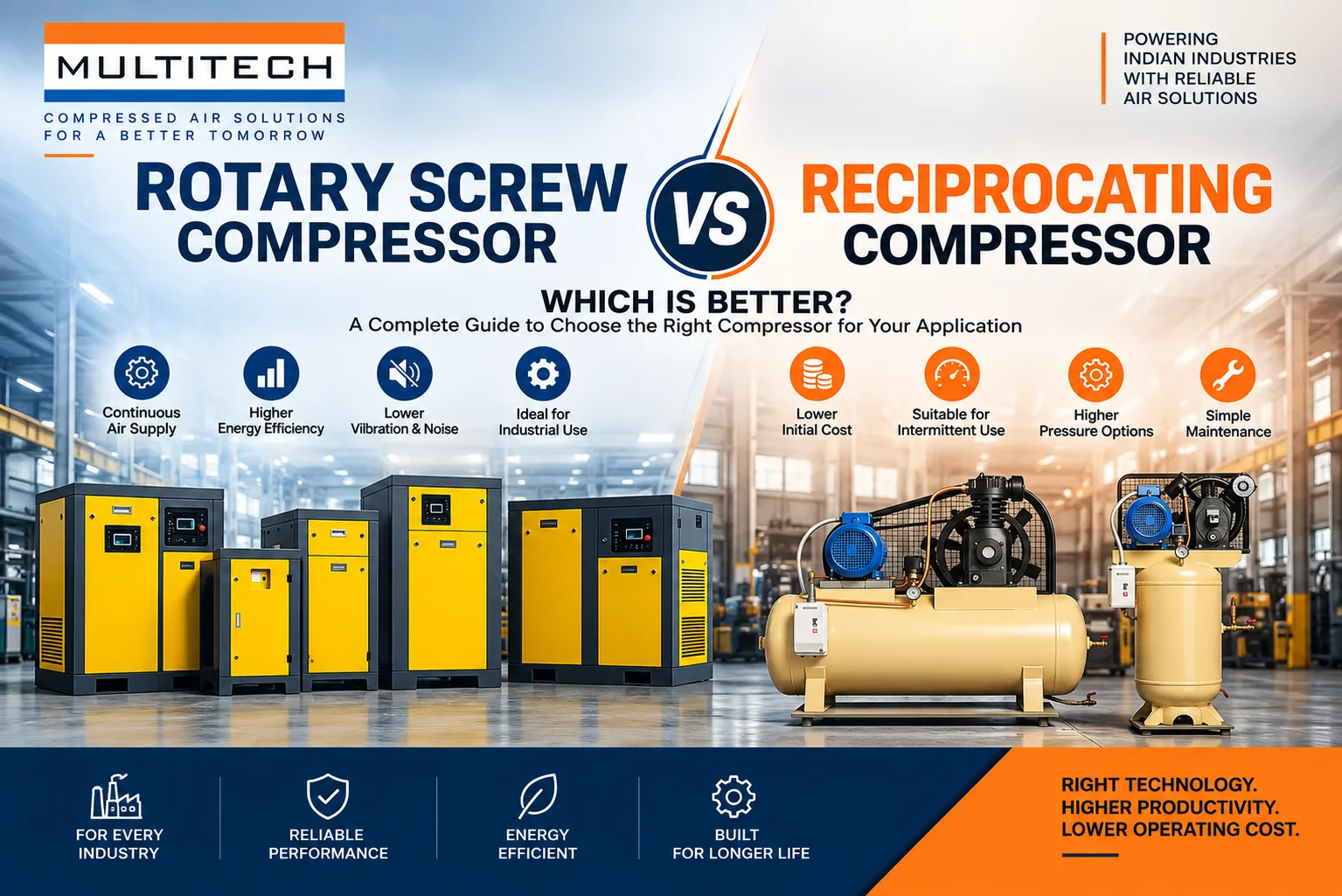
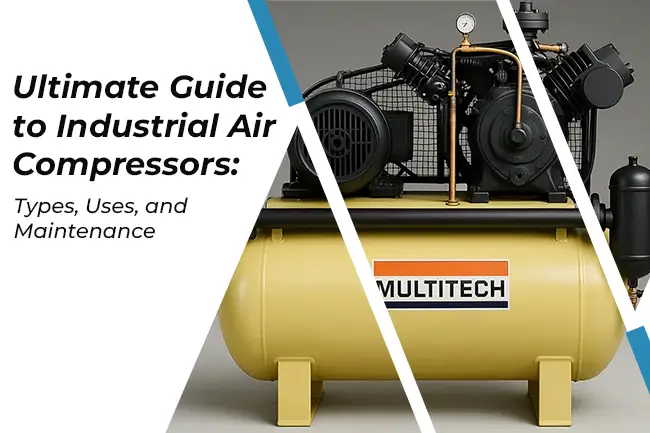
Reciprocating or piston compressors suit intermittent demand, workshops, service areas and small or medium production applications. They are familiar, comparatively accessible and available in single-stage and two-stage designs. A receiver helps absorb short demand peaks and reduces frequent starts.
Their limitations matter in a factory. Airflow is pulsating, noise and vibration can be higher, and continuous heavy-duty use may require rest periods or a carefully selected industrial model. If the plant runs multiple shifts with a stable base load, compare the lifecycle case with a rotary screw compressor.
Rotary screw compressors
Rotary screw compressors are commonly selected for continuous industrial operation because they provide a steady supply of compressed air. They are available in fixed-speed and variable-speed configurations, with different pressure and capacity ranges. A fixed-speed unit can be efficient under a stable high load, while a variable-speed model may help where demand varies significantly.
The decision should be based on an actual load profile rather than the assumption that variable speed is always cheaper. A higher purchase price may be justified when the compressor spends meaningful time at part load, but the saving depends on operating hours, electricity tariff, control settings and maintenance.
Oil-free compressors
Oil-free compressors are used where oil contamination presents a product, process or quality risk. Food and beverage, pharmaceutical, medical, laboratory, electronics and certain packaging operations may need clean compressed air. Oil-free reciprocating, scroll and screw technologies have different capacities, pressure limits, noise levels and service requirements.
Specify the required air-quality class and the complete treatment train. “Oil-free” does not mean that the plant can ignore moisture, particles, receiver hygiene or point-of-use filtration. The correct configuration depends on what the air touches and what the process can tolerate.
High-pressure and application-specific systems
PET bottle blowing, specialised testing, process air and other applications may require high-pressure or multi-stage systems. These packages can include boosters, inter-coolers, aftercoolers, receivers, dryers and controls. Their selection must be linked to production output, cycle time, pressure stability and redundancy rather than compared with a general workshop compressor.
Step 5 Match air quality to the process
Compressed air quality has three main concerns: particles, water and oil. A general fabrication tool may tolerate a different air condition from a pharmaceutical process or a product-contact application. The required cleanliness and dew point should be defined before selecting the dryer and filters.
A refrigeration dryer is often used for general industrial air where a moderate pressure dew point is acceptable. A desiccant dryer may be considered when a lower dew point is required. Filters remove particles, oil aerosols and moisture according to their design, but each filter also creates pressure drop and needs maintenance.
Air treatment changes the compressor requirement. Filters and dryers consume some pressure, and blocked elements increase the loss. Include drains, condensate handling, service access and replacement intervals in the specification. A clean, dry system reduces the risk of corrosion and pneumatic equipment failure.
Step 6 Consider factory conditions
The compressor room should have adequate ventilation, clean intake air, safe electrical supply and enough space for maintenance. High ambient temperature reduces cooling performance and may affect output. Dust can load intake filters and coolers. Humidity increases condensate. These conditions should be shared with the supplier before final selection.
Noise and vibration may influence the installation location, especially near offices, laboratories or inspection areas. The foundation, lifting path, access doors, drainage and piping route should be reviewed before delivery. A machine that fits on paper can still become difficult to maintain if there is no space to remove filters, separators or belts.
Step 7 Compare energy and total ownership cost
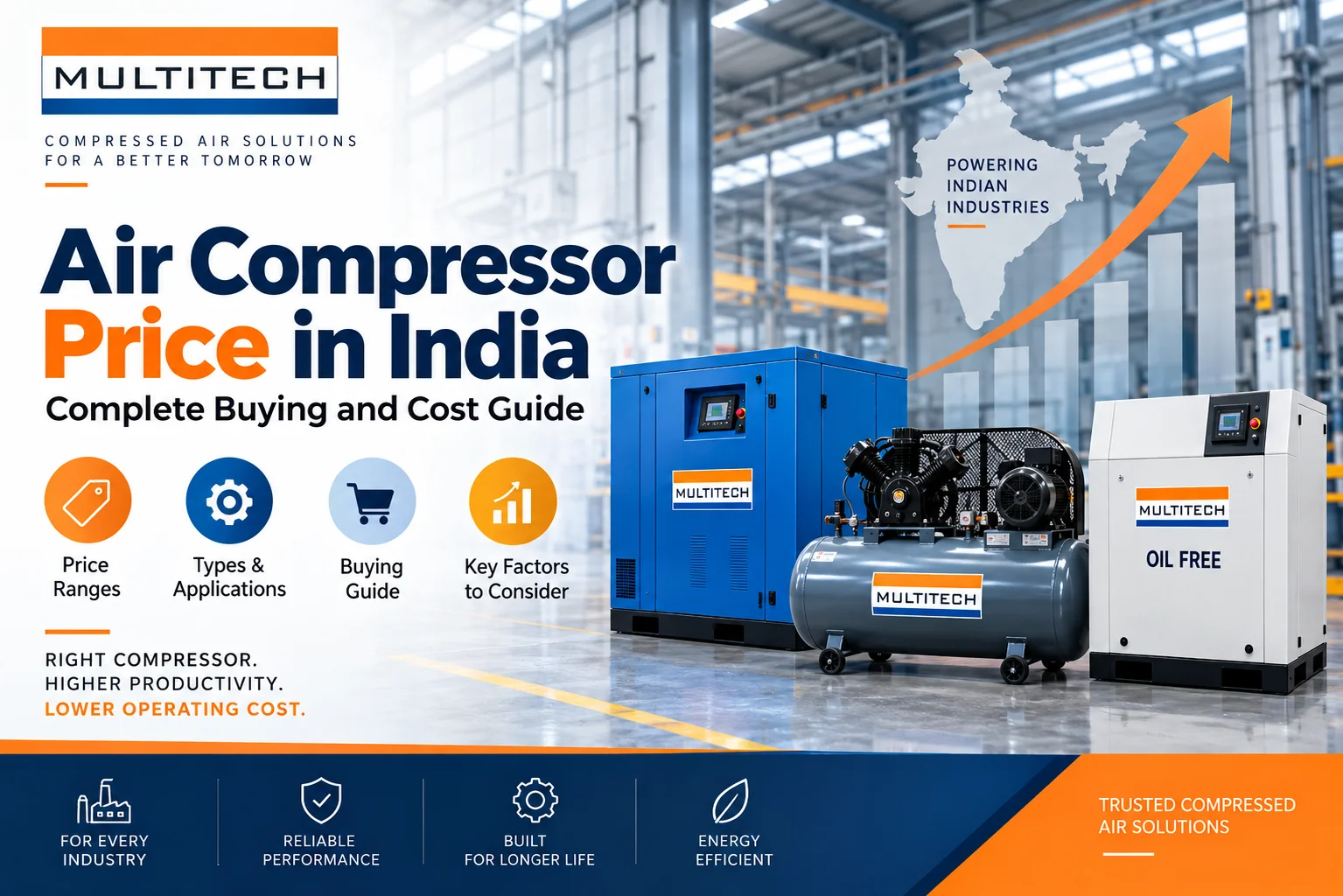
The purchase price is only one part of industrial compressor cost. Electricity, lubricant, filters, separator elements, dryer operation, maintenance labour, leaks and downtime can exceed the initial equipment cost over years of operation. Ask suppliers to explain the assumptions behind any energy-saving claim.
A useful comparison includes rated power, specific power, expected operating hours, average load, pressure setting and electricity tariff. It should also show maintenance intervals and the cost of normal consumables. Where demand changes through the day, consider sequencing two smaller compressors or combining a base-load unit with a trim compressor. The best arrangement depends on the load profile.
Leak management deserves attention. A compressor may be correctly sized while the distribution network wastes a large share of its output. Repairing leaks, reducing unnecessary pressure and improving pipe layout can lower running cost without buying a larger compressor.
Step 8 Specify the complete package
A factory quotation should make the scope visible. Ask whether it includes the compressor, motor, starter or drive, controller, receiver, aftercooler, moisture separator, dryer, filters, auto drains, piping, cables, foundation work, commissioning, training, GST, freight and unloading. Exclusions should be written clearly.
| Package element | Why it may be needed |
|---|---|
| Air receiver | Stores air and manages short peaks |
| Aftercooler and separator | Reduces hot moisture after compression |
| Dryer | Controls moisture for the process |
| Line filters | Protects equipment and product |
| Auto drain | Removes condensate reliably |
| Controller and sequencing | Coordinates compressors with demand |
| Installation and commissioning | Verifies safe, correct operation |
One offer may show only the compressor price; another may include the receiver and dryer. Ask for a line-item commercial and technical schedule so the decision is based on equivalent scope.
Step 9 Review reliability and service support
Reliability comes from suitable design, correct installation and planned maintenance. Ask about service response, genuine spares, lubricant specifications, filter availability, warranty conditions and recommended preventive-maintenance intervals. A low-cost compressor can become expensive if a critical part takes weeks to obtain or if the buyer cannot access technical support.
A manufacturer should be able to discuss the application rather than only quote a model number. Multitech Compressors manufactures and supplies compressor products, air dryers and filters from its Faridabad base for customers across India.
A practical buyer checklist
- List all air-consuming machines and their actual pressure and flow requirements.
- Convert demand into one unit and identify simultaneous peak demand.
- Specify FAD at the required working pressure, not horsepower alone.
- Decide whether demand is intermittent, continuous, variable or seasonal.
- Define oil, particle and moisture requirements for the process.
- Check room temperature, dust, humidity, ventilation and electrical conditions.
- Compare fixed-speed, variable-speed, reciprocating and screw options on lifecycle cost.
- Include receiver, dryer, filters, drains, piping, installation and commissioning in the scope.
- Ask for maintenance intervals, consumables, warranty terms and service coverage.
- Keep a written technical comparison sheet with the purchase approval.
Common selection mistakes
The most common mistake is choosing a machine from the connected motor load without calculating air demand. Another is using a large safety margin that hides poor measurement. Oversizing may cause low-load inefficiency; undersizing may create pressure drops and production interruptions.
Other mistakes include ignoring air treatment, putting the compressor in a hot dusty room, allowing leaks to continue, choosing a dryer without checking dew point, and treating installation as an afterthought. The machine, receiver, dryer, filters and distribution system should be reviewed together.
Frequently asked questions
1. What is the most important factor in industrial air compressor selection?
The most important factor is the compressor’s ability to deliver the required FAD at the required working pressure during the factory’s real peak and average demand. Motor horsepower alone is not enough. Duty cycle, air quality, operating environment, controls and service support should be checked before final selection.
2. How do I calculate air compressor sizing for a factory?
List every air-consuming machine, record its flow and pressure, convert the figures into one unit, identify equipment that can run simultaneously and add a reasonable evidence-based allowance for leakage and growth. Compare the result with the compressor’s FAD at the required pressure.
3. What does compressor capacity mean?
Compressor capacity is the amount of compressed air a machine can deliver under stated conditions. It is commonly expressed in CFM, m³/min or litres per minute. Buyers should confirm whether the quoted figure is FAD and identify the pressure, temperature and test conditions attached to it.
4. Should I choose a reciprocating or rotary screw industrial compressor?
Choose based on demand pattern. Reciprocating compressors can suit intermittent use and smaller requirements. Rotary screw compressors are generally considered for continuous operation and stable plant air. Compare duty cycle, noise, maintenance, energy consumption, capacity and future expansion before deciding.
5. Is a variable-speed compressor always the best choice?
No. Variable-speed control may reduce energy waste when demand changes substantially, but it usually carries a higher initial cost and must be evaluated against operating hours, load profile and electricity tariff. A fixed-speed compressor can be suitable for a stable, high base load.
6. How much compressor capacity should I keep for future expansion?
Future capacity should be based on a realistic production plan, not an arbitrary large percentage. Define the likely additional machines, their expected demand and the timing. In some factories, a modular arrangement or a second compressor is more practical than buying one oversized unit at the beginning.
7. What pressure should an industrial compressor provide?
The pressure should be based on the highest point-of-use requirement plus the measured loss through piping, valves, filters and dryers. Producing much higher pressure than needed increases energy use. Correct leaks and pressure drops before increasing the compressor setting.
8. Do I need a dryer with an industrial compressor?
Many factories need a dryer because compressed air naturally carries moisture. The correct dryer depends on the process, ambient conditions and required pressure dew point. General plant air may use refrigeration drying, while lower dew points may require desiccant drying.
9. What is FAD and why is it important?
FAD means free air delivery. It describes the equivalent volume of air delivered by the compressor under stated conditions. It is important because it gives a more meaningful basis for comparing usable output than a generic CFM or motor horsepower figure.
10. How does air compressor sizing affect electricity cost?
An undersized compressor may run continuously at high load and still fail to meet demand. An oversized compressor may spend more time unloading or cycling inefficiently. Matching capacity and controls to the load profile helps reduce unnecessary electrical consumption.
11. Can one compressor supply an entire factory?
It can, if its capacity, pressure, air quality and distribution system meet the factory’s demand with suitable reliability. Large plants may use multiple compressors for redundancy, sequencing, maintenance flexibility or separate pressure levels.
12. What information should I send to a compressor manufacturer?
Share application, air consumption, required pressure, operating hours, number of shifts, power supply, air-quality needs, site location, room conditions, future expansion and delivery timeline. Equipment lists, existing compressor data and photographs can improve the recommendation.
13. How often does an industrial air compressor need maintenance?
The interval depends on compressor type, operating hours, ambient conditions and the manufacturer’s instructions. Maintenance may include filters, lubricant, separator elements, coolers, belts, drains, electrical connections and safety devices.
14. Does Multitech Compressors supply industrial compressors across India?
Multitech Compressors is based in Faridabad and supplies compressor products and related air-treatment equipment across India. Delivery, installation and service arrangements should be confirmed for the specific factory location, equipment configuration and project timeline.
Request an evaluation for your needs
A sound industrial air compressor selection starts with the factory’s work, not with a catalogue horsepower number. Measure or estimate demand carefully, specify FAD at pressure, define air quality, examine the duty cycle and compare the complete package. Then include energy, maintenance, installation and service support in the commercial decision.
If you are evaluating an industrial compressor for a new line, replacement project or capacity expansion, share your application, pressure, air consumption, operating hours, power supply, air-quality requirement, location and expected timeline with Multitech Compressors. A technical discussion can help narrow the suitable compressor type and package before you request a final quotation.